The Complete Guide to Iran’s Geography, Culture and Administrative Structure
Iran is one of the world’s oldest civilizations and one of the most geographically diverse countries in Asia. Known historically as Persia, Iran stretches from the Caspian Sea in the north to the Persian Gulf and Gulf of Oman in the south, encompassing mountains, deserts, forests, islands, ancient cities, and thousands of villages.
Today, Iran is home to more than 90 million people and is divided into 31 provinces, hundreds of counties, over 1,200 cities and towns, and tens of thousands of villages. Each region contributes its own traditions, architecture, language, cuisine, and cultural identity to the rich tapestry of Iranian life.
This guide explores Iran’s administrative structure, major provinces, famous cities, historic towns, and remarkable villages while highlighting the country’s cultural and historical significance.
Understanding Iran’s Administrative Structure
Iran operates through a multi-level administrative system designed to manage its vast territory efficiently.
Administrative Hierarchy
- Province (Ostan)
- County (Shahrestan)
- District (Bakhsh)
- City or Town (Shahr)
- Village (Deh)
Each province has a capital city and local government responsible for administration, infrastructure, education, healthcare, and regional development.
This system allows Iran to govern regions that range from the snowy peaks of the Alborz Mountains to the deserts of central Iran and the coastal communities along the Persian Gulf.
The 31 Provinces of Iran
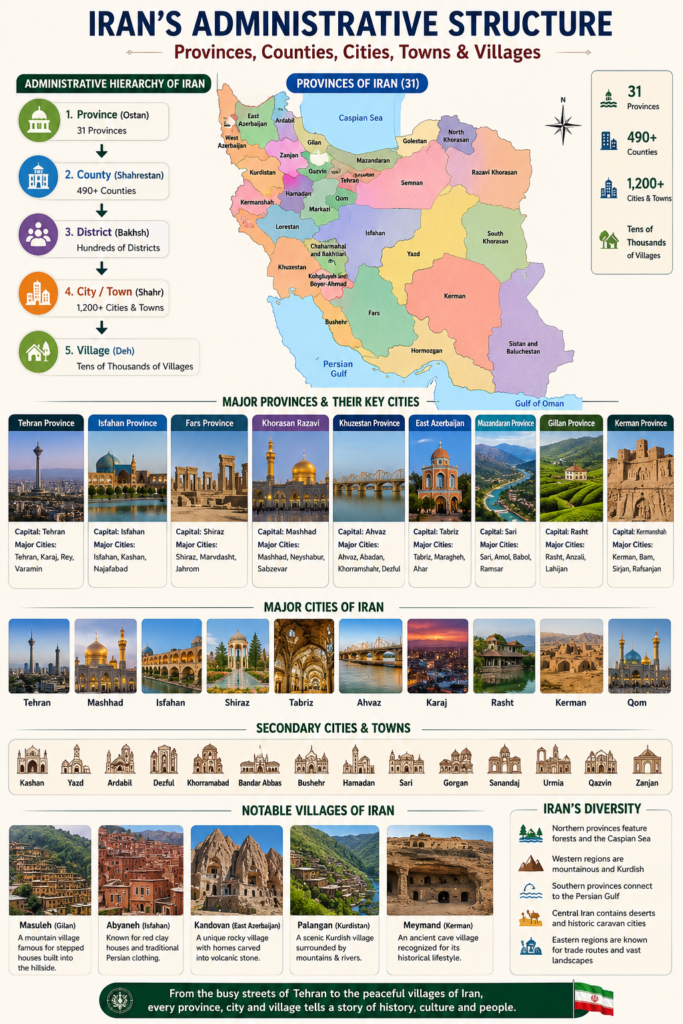
Iran is divided into 31 provinces, each possessing unique geographical features and cultural traditions.
Some of the most influential provinces include:
Tehran Province
Capital: Tehran
The political, economic, and administrative heart of Iran. It contains the nation’s capital and serves as the country’s primary financial and business center.
Isfahan Province
Capital: Isfahan
Known for magnificent Persian architecture, historic bridges, mosques, and UNESCO World Heritage sites.
Fars Province
Capital: Shiraz
Often regarded as the birthplace of Persian civilization and home to the ancient city of Persepolis.
Razavi Khorasan Province
Capital: Mashhad
Iran’s most important religious destination and one of the largest pilgrimage centers in the Islamic world.
East Azerbaijan Province
Capital: Tabriz
A historical crossroads connecting Iran with the Caucasus and Anatolia.
Khuzestan Province
Capital: Ahvaz
A vital economic region rich in oil resources and industrial development.
Mazandaran Province
Capital: Sari
Famous for forests, beaches, and the southern coastline of the Caspian Sea.
Gilan Province
Capital: Rasht
Known for lush landscapes, rice fields, tea plantations, and exceptional cuisine.
Kerman Province
Capital: Kerman
Iran’s largest province by area, featuring deserts, ancient citadels, and mining industries.
Kermanshah Province
Capital: Kermanshah
A center of Kurdish culture and home to numerous archaeological treasures.
Iran’s Major Counties
Counties serve as regional administrative centers and often contain multiple cities, towns, and villages.
Important counties include:
- Tehran County
- Isfahan County
- Shiraz County
- Mashhad County
- Tabriz County
- Ahvaz County
- Karaj County
- Rasht County
- Kerman County
- Abadan County
These counties play critical roles in transportation, education, commerce, agriculture, and public administration.
The Most Famous Cities in Iran
Iran’s cities are among the oldest continuously inhabited urban centers in the world. Many flourished along ancient trade routes such as the Silk Road and served as capitals of Persian empires.
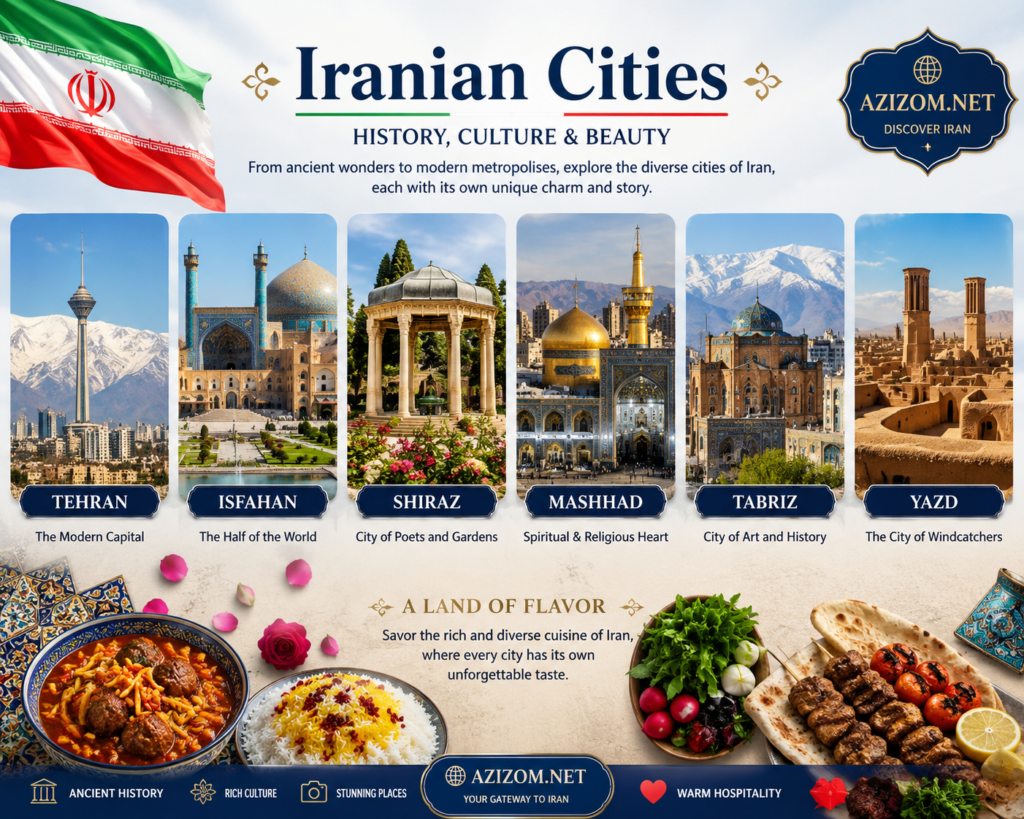
Tehran – Iran’s Modern Capital
Tehran is the largest city in Iran and the nation’s political and economic powerhouse.
Highlights:
- Golestan Palace
- Azadi Tower
- Milad Tower
- Tehran Grand Bazaar
- National Museum of Iran
Tehran combines modern skyscrapers, historical landmarks, museums, and vibrant cultural life.
Isfahan – The Jewel of Persia
Known worldwide for its stunning architecture, Isfahan was once the capital of the Safavid Empire.
Highlights:
- Naqsh-e Jahan Square
- Shah Mosque
- Ali Qapu Palace
- Si-o-se-pol Bridge
- Khaju Bridge
The city is famous for Persian craftsmanship, miniature painting, tilework, and carpet weaving.
Shiraz – City of Poetry and Gardens
Shiraz is often considered Iran’s cultural capital.
Highlights:
- Tomb of Hafez
- Tomb of Saadi
- Eram Garden
- Nasir al-Mulk Mosque
- Vakil Bazaar
Nearby lies Persepolis, the ceremonial capital of the Achaemenid Empire and one of the world’s most important archaeological sites.
Mashhad – Spiritual Heart of Iran
Mashhad attracts millions of pilgrims every year.
Highlights:
- Imam Reza Holy Shrine
- Museums and libraries
- Historic bazaars
- Religious and cultural centers
The city is one of the most visited religious destinations in the world.
Tabriz – Gateway to the Silk Road
Tabriz has been an important commercial center for centuries.
Highlights:
- Tabriz Historic Bazaar Complex
- Blue Mosque
- El Goli Park
- Azerbaijan Museum
The city is renowned for producing some of the world’s finest Persian carpets.
Yazd – The Ancient Desert City
Yazd is one of the oldest desert cities on Earth and a UNESCO World Heritage Site.
Highlights:
- Windcatchers (Badgirs)
- Jameh Mosque of Yazd
- Towers of Silence
- Historic Old Town
The city preserves ancient Persian desert architecture and Zoroastrian heritage.
Kerman
Known for deserts, traditional bazaars, pistachios, and historical landmarks.
Highlights:
- Ganjali Khan Complex
- Rayen Castle
- Shahdad Desert
- Lut Desert
Rasht
Located near the Caspian Sea, Rasht is famous for food, culture, and green landscapes.
Highlights:
- Traditional markets
- Local cuisine
- Tea plantations
- Caspian culture
Ahvaz
A major industrial city built along the Karun River, Iran’s longest river.
Highlights:
- Historic bridges
- Riverfront areas
- Oil and energy industries
Qom
One of the holiest cities in Iran and a major center for Islamic scholarship.
Important Secondary Cities and Regional Centers
Beyond the major metropolitan areas, many smaller cities contribute significantly to Iran’s identity.
These include:
- Kashan
- Hamadan
- Ardabil
- Bandar Abbas
- Bushehr
- Urmia
- Gorgan
- Sari
- Qazvin
- Semnan
- Zanjan
- Sanandaj
- Khorramabad
- Dezful
Many of these cities contain UNESCO-listed monuments, ancient bazaars, and centuries-old traditions.
Famous Villages of Iran
Iran’s villages preserve some of the country’s oldest traditions and architectural styles.
Masuleh (Gilan)
A unique mountain village where rooftops serve as pedestrian pathways.
Abyaneh (Isfahan)
Known for red-clay houses and traditional Persian clothing.
Kandovan (East Azerbaijan)
Famous for cave-like homes carved directly into volcanic rock.
Palangan (Kurdistan)
A spectacular Kurdish village built along steep mountain slopes.
Meymand (Kerman)
An ancient cave settlement recognized for its unique lifestyle and cultural significance.
These villages provide insight into Iran’s rural heritage and traditional ways of life.
Cultural Diversity Across Iran
Iran is home to a rich mixture of ethnic groups and cultures, including:
- Persians
- Azerbaijanis
- Kurds
- Lurs
- Gilaks
- Mazandaranis
- Arabs
- Baluchis
- Turkmens
Each region contributes unique music, cuisine, clothing, language, architecture, and customs.
Traditional Architecture of Iranian Cities
Iranian cities are globally recognized for architectural achievements developed over thousands of years.
Common features include:
- Grand domes
- Colorful tilework
- Persian gardens
- Courtyard houses
- Windcatchers
- Minarets
- Decorative calligraphy
These innovations influenced architecture throughout Central Asia, the Middle East, and beyond.
Famous Foods from Iranian Cities
Every region has its own culinary specialties.
Popular examples include:
Tehran
Persian kebabs and modern Iranian cuisine
Isfahan
Beryani
Shiraz
Kalam Polo
Tabriz
Kufteh Tabrizi
Rasht
Mirza Ghasemi and Baghala Ghatogh
Mashhad
Sholeh Mashhadi
Yazd
Qottab, Baklava, and traditional sweets
Iranian cuisine is famous for saffron, rice, herbs, fruits, nuts, and aromatic spices.
Tourism in Iranian Cities
Iran offers remarkable attractions for travelers interested in:
- Ancient history
- Persian civilization
- UNESCO World Heritage Sites
- Islamic architecture
- Religious tourism
- Mountain adventures
- Desert landscapes
- Traditional villages
- Persian cuisine
From the bustling streets of Tehran to the quiet mountain villages of northern Iran, visitors can experience thousands of years of living history.
Conclusion
Iran’s provinces, counties, cities, towns, and villages together form one of the most diverse cultural landscapes in the world. Every region tells a unique story of Persian civilization, ancient trade routes, architectural achievement, and cultural heritage.
Whether exploring the magnificent mosques of Isfahan, the poetic gardens of Shiraz, the spiritual atmosphere of Mashhad, the historic bazaars of Tabriz, or the traditional villages hidden among mountains and deserts, visitors discover a nation whose history spans millennia.
Iran is far more than a collection of administrative divisions—it is a living civilization where every province, city, and village contributes to the enduring legacy of Persia.