The Industrial Heart of Iran and City of Bridges
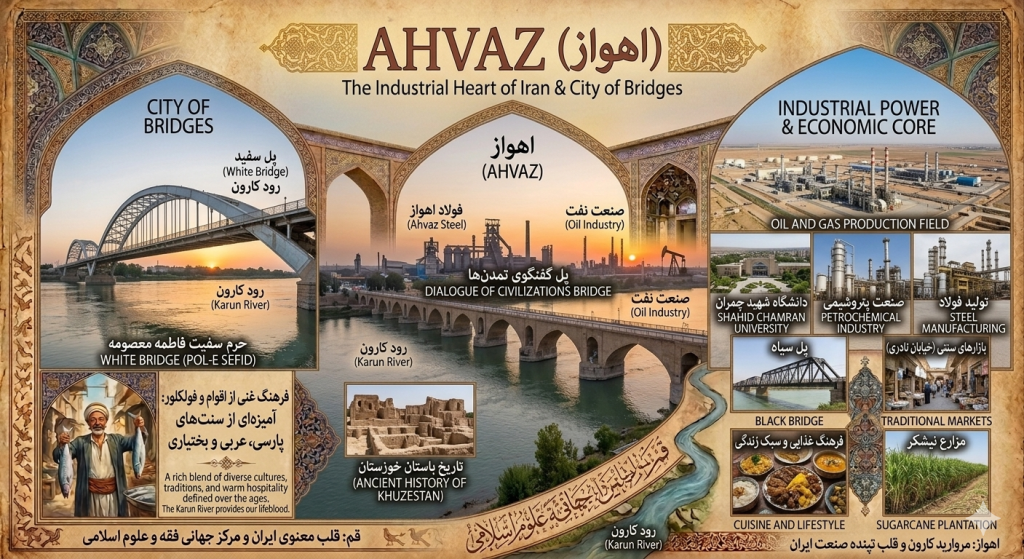
Ahvaz is one of Iran’s most important and dynamic cities, located in the southwest of the country and serving as the capital of Khuzestan Province. Built along the banks of the mighty Karun River—the longest river in Iran—Ahvaz is a city that blends ancient history, industrial power, and cultural diversity into a unique urban identity.
Often referred to as the “City of Bridges” and the “Oil Capital of Iran,” Ahvaz plays a major role in the country’s economy, energy production, and transportation network.
📍 Location and Geography
Ahvaz is situated in a lowland region close to the Iraqi border. The Karun River flows directly through the city, dividing it into eastern and western parts and giving rise to numerous modern bridges that connect its districts.
The city experiences a hot desert climate, with extremely high summer temperatures that can exceed 45°C. Winters are generally mild and short, with occasional rainfall. Seasonal dust storms are also a known environmental challenge in the region.
🏛️ Ancient History of Ahvaz
The history of Ahvaz stretches back thousands of years. Archaeological and historical records suggest that the area was inhabited during the Elamite and Achaemenid periods.
During the Sassanid Empire, the city was rebuilt and developed as a strategic trade and irrigation center under the name Hormuz-Ardashir. Later, after the Arab conquest in the 7th century, it became known as “Souq al-Ahvaz” (Market of Ahvaz) due to its importance as a commercial hub.
Over time, the city declined due to environmental and political changes but regained importance in the modern era with the discovery of oil in Khuzestan.
🛢️ Economy and Industry
Today, Ahvaz is one of Iran’s key industrial centers. Its economy is strongly linked to:
- Oil and gas production
- Petrochemical industries
- Steel manufacturing
- Agriculture (especially sugarcane and rice in surrounding areas)
- Transportation and logistics
The city’s strategic position near Iran’s largest oil fields has made it a backbone of the national energy sector.
🌉 City of Bridges
One of the most iconic features of Ahvaz is its series of bridges crossing the Karun River. These bridges are not only functional but also symbolic landmarks of the city’s modern identity.
Famous bridges include:
- White Bridge (Pol-e Sefid)
- Black Bridge (Victory Bridge)
- Naderi Bridge
- Modern “Dialogue of Civilizations” Bridge
These structures make Ahvaz visually distinctive and have earned it the nickname “City of Bridges.”
👥 Culture and People
Ahvaz is one of the most culturally diverse cities in Iran. It is home to different ethnic and linguistic groups, including Persians, Arabs, Bakhtiari, and others.
This diversity is reflected in:
- Local traditions
- Music and dance
- Cuisine
- Daily lifestyle and markets
The city is known for its warm hospitality and strong community culture.
🎓 Education and Urban Development
Ahvaz is also an academic center in southwestern Iran. One of its most important institutions is Shahid Chamran University, which contributes to research and higher education in science, engineering, and humanities.
In recent decades, the city has expanded significantly, with new infrastructure, highways, and industrial zones supporting its growing population.
⚠️ Climate and Environmental Challenges
Despite its importance, Ahvaz faces several environmental challenges:
- Extreme summer heat
- Frequent dust and sand storms
- Air pollution from heavy industry and oil refineries
These issues have made environmental management a key concern for the city’s future development.
📌 Conclusion
Ahvaz is a city where ancient civilization meets modern industry. From its historical roots along the Karun River to its role as Iran’s oil powerhouse, the city continues to shape the economic and cultural landscape of the region.
Despite environmental challenges, Ahvaz remains a vital and resilient urban center with deep historical significance and strategic importance.