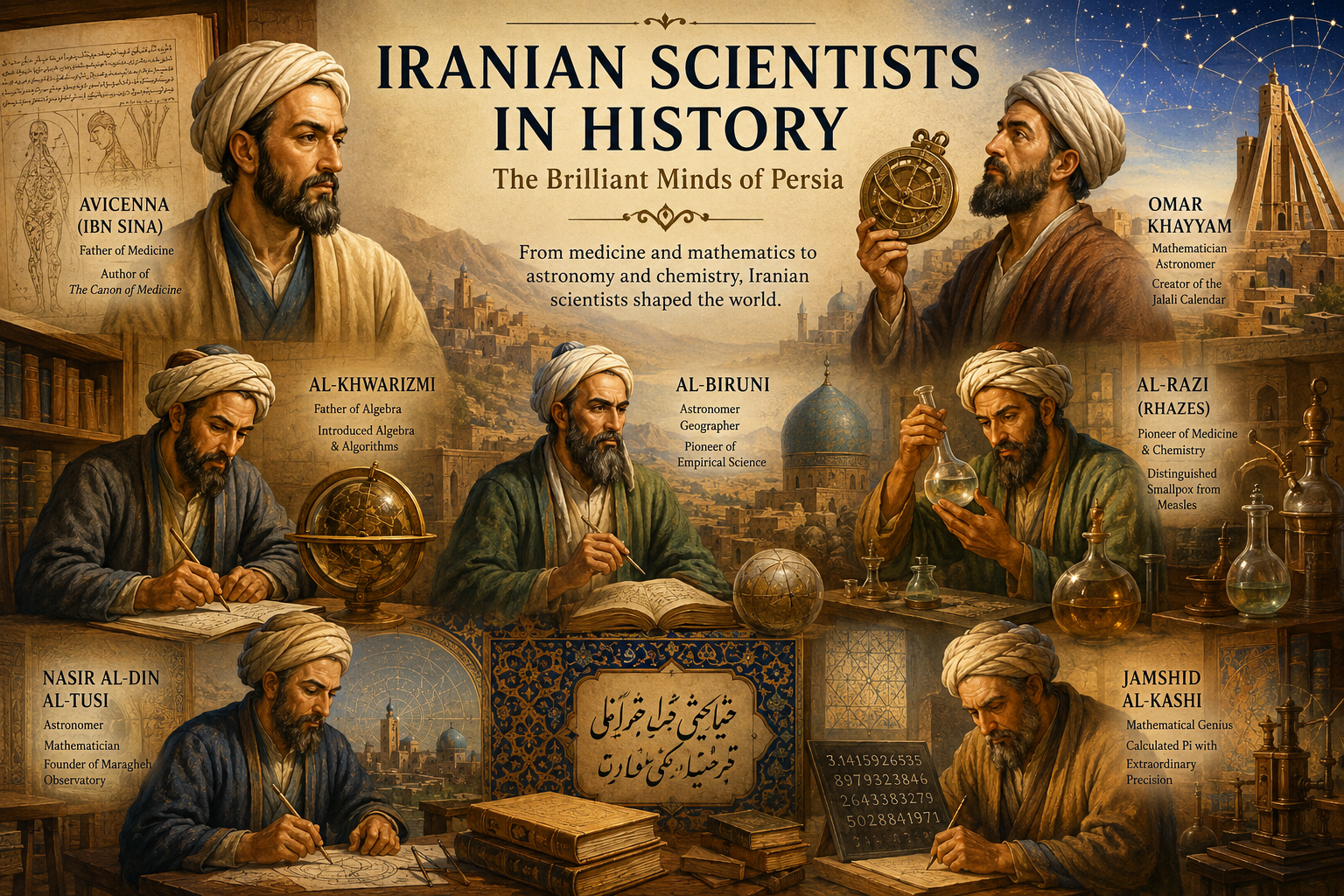
The Brilliant Minds of Persia
Introduction
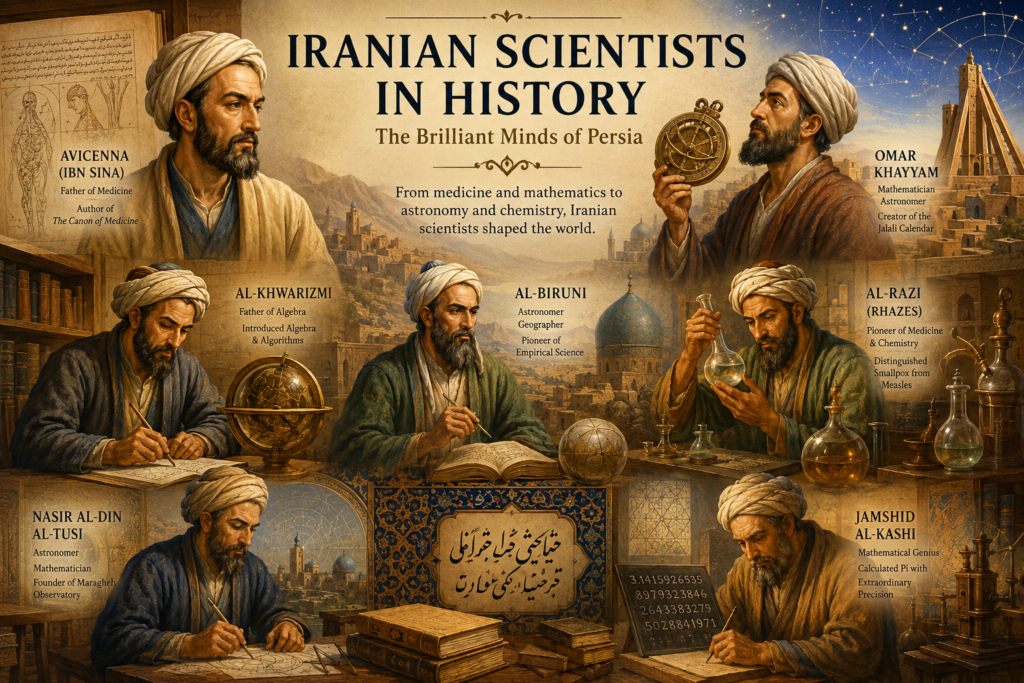
Throughout history, Iran (historically known as Persia) has been home to some of the world’s greatest scientists, mathematicians, physicians, astronomers, and philosophers. Long before the modern scientific era, Persian scholars were making groundbreaking discoveries that influenced civilizations across Asia, the Middle East, and Europe.
From medicine and mathematics to astronomy and chemistry, Iranian scientists helped preserve ancient knowledge while creating new theories and innovations that shaped human progress. Their works were translated into Arabic, Latin, and many other languages, becoming essential references for centuries.
This article explores the lives and achievements of some of the most influential Iranian scientists in history.
The Golden Age of Persian Science
The period between the 8th and 13th centuries is often called the Islamic Golden Age. During this era, many Persian scholars led scientific advancement across the known world.
Major centers of learning flourished in cities such as:
- Nishapur
- Ray
- Isfahan
- Shiraz
- Maragheh
These cities became hubs for research, libraries, observatories, and medical schools.
Avicenna (Ibn Sina): The Father of Early Medicine
Avicenna (980–1037) is widely regarded as one of the greatest physicians in history.
Major Contributions
- Authored The Canon of Medicine
- Systematized medical knowledge of his time
- Studied anatomy, diseases, and pharmacology
- Influenced medical education in Europe for over 600 years
His medical encyclopedia became a standard textbook in many European universities until the 17th century.
Legacy
Many historians consider Avicenna one of the founders of modern medicine because of his scientific approach to diagnosis and treatment.
Al-Khwarizmi: The Father of Algebra
Muhammad ibn Musa al-Khwarizmi (c. 780–850) revolutionized mathematics.
Major Contributions
- Developed the foundations of algebra
- Introduced systematic equation-solving methods
- Popularized Hindu-Arabic numerals
- Inspired the word “algorithm,” derived from his name
Why He Matters
Modern computing, programming, and mathematics rely heavily on concepts that originated from Al-Khwarizmi’s work.
Al-Biruni: Master of Astronomy and Geography
Al-Biruni (973–1048) was one of the most versatile scientists of the medieval world.
Achievements
- Calculated Earth’s radius with remarkable accuracy
- Studied astronomy and planetary motion
- Advanced geography and cartography
- Conducted detailed studies of cultures and languages
His scientific methods emphasized observation and measurement, making him a pioneer of empirical research.
Omar Khayyam: Mathematician and Astronomer
Omar Khayyam (1048–1131) is famous worldwide for his poetry, but his scientific achievements were equally impressive.
Scientific Contributions
- Advanced algebraic geometry
- Solved cubic equations
- Developed an extremely accurate solar calendar
- Led astronomical observations in Persia
The Jalali Calendar
The calendar developed under Khayyam’s supervision is considered one of the most accurate solar calendars ever created.
Zakariya al-Razi (Rhazes): Pioneer of Medicine and Chemistry
Muhammad ibn Zakariya al-Razi (865–925) made groundbreaking discoveries in medicine.
Key Achievements
- Distinguished smallpox from measles
- Wrote influential medical textbooks
- Advanced clinical observation techniques
- Conducted early chemical experiments
Influence
European physicians studied his medical works for centuries, and many of his methods remain recognizable in modern medicine.
Nasir al-Din al-Tusi: Astronomer and Mathematician
Nasir al-Din al-Tusi (1201–1274) was among the greatest scholars of the medieval period.
Contributions
- Established the famous Maragheh Observatory
- Improved astronomical models
- Advanced trigonometry as a separate mathematical discipline
- Influenced later European astronomers
His work laid important foundations for future developments in astronomy.
Jamshid al-Kashi: Mathematical Genius
Jamshid al-Kashi (1380–1429) made remarkable advances in numerical mathematics.
Achievements
- Calculated pi with extraordinary precision
- Improved decimal fraction calculations
- Developed sophisticated computational methods
His calculations remained among the most accurate in the world for generations.
Persian Contributions to Science
Iranian scientists contributed significantly to many fields:
Medicine
- Hospitals and medical education
- Pharmacology
- Surgery
- Disease classification
Mathematics
- Algebra
- Geometry
- Trigonometry
- Numerical analysis
Astronomy
- Star catalogues
- Planetary observations
- Calendar design
- Observatory construction
Chemistry
- Distillation techniques
- Laboratory equipment
- Experimental methods
Philosophy
- Logic
- Ethics
- Natural sciences
Lasting Global Impact
The scientific achievements of Persian scholars crossed cultural and geographical boundaries. Their books were translated into Arabic, Latin, Turkish, and many European languages.
Many ideas developed by Iranian scientists later influenced:
- The European Renaissance
- Modern medicine
- Mathematics
- Astronomy
- Engineering
- Computer science
Their work demonstrates the important role Persia played in the development of global knowledge.
Conclusion
The history of Iranian science is a story of innovation, curiosity, and intellectual achievement. Scientists such as Avicenna, Al-Khwarizmi, Al-Biruni, Omar Khayyam, Al-Razi, Al-Tusi, and Al-Kashi transformed medicine, mathematics, astronomy, and many other fields.
Their discoveries continue to influence modern science and remind us that Persia was one of the world’s great centers of learning and scholarship. By studying their contributions, we gain a deeper appreciation for Iran’s rich scientific heritage and its lasting impact on human civilization.
Azizom.net celebrates the remarkable achievements of Persian scientists whose knowledge helped shape the modern world.