A Historic Desert City of Culture, Trade, and Timeless Heritage
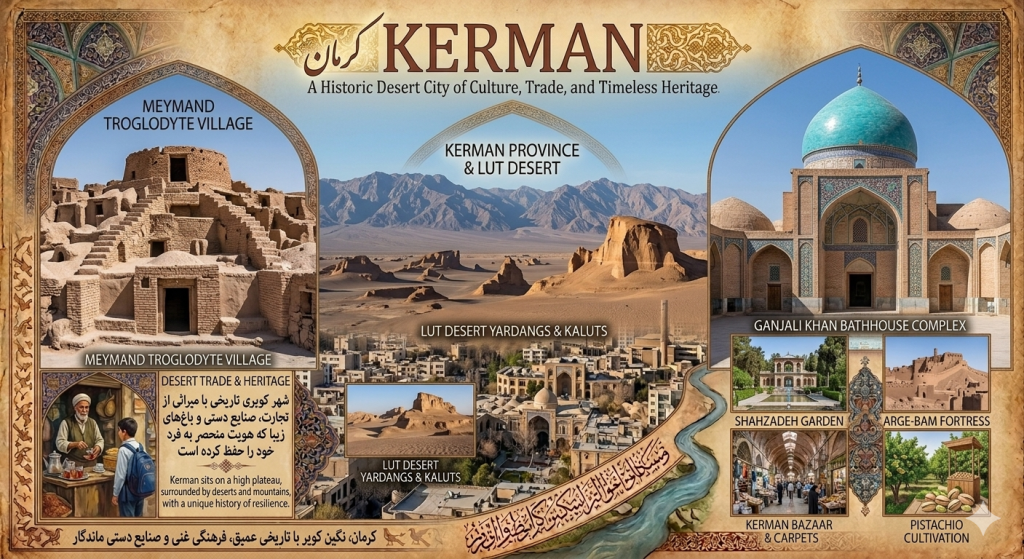
Kerman is one of Iran’s most fascinating yet often overlooked cities. Located in the southeastern part of the country, it serves as the capital of Kerman Province and sits on a high plateau surrounded by rugged mountains and vast desert landscapes. This unique setting has shaped its identity for centuries, blending resilience, trade, and culture into a city with a distinct character unlike anywhere else in Iran.
🌄 A City Between Desert and Mountains

Kerman lies at an altitude of around 1,700 meters above sea level, which gives it a noticeably cooler climate compared to many other desert cities in Iran. Despite being close to some of the hottest regions on Earth—especially the famous Lut Desert (Dasht-e Lut)—the city itself enjoys relatively moderate temperatures for much of the year.
This contrast between harsh desert surroundings and livable urban conditions has historically made Kerman an important stopping point for travelers, traders, and caravans.
🏛️ A Deep Historical Legacy


The history of Kerman stretches back many centuries, with roots likely reaching the Sasanian era, though the region itself is even older. Over time, it developed into a strategically important city along trade routes connecting central Iran with the Persian Gulf and South Asia.
During the Safavid period, Kerman flourished significantly. Many of its most famous architectural landmarks date back to this era, including sections of its bazaars and public complexes. Despite periods of invasion and destruction throughout history, the city repeatedly rebuilt itself, maintaining its role as a regional center.
One of the most notable historic landmarks is the Ganjali Khan Complex, a masterpiece of Safavid architecture that includes a bazaar, bathhouse, square, and caravanserai.
🧵 Economy, Crafts, and Local Life

Kerman is widely known for its strong tradition of craftsmanship and agriculture. The city and its surrounding region contribute significantly to Iran’s economy in several ways:
- 🧶 Handwoven carpets: Kerman carpets are among the most recognized Persian carpets globally, known for intricate designs and high quality.
- 🌰 Pistachio production: Nearby areas, especially Rafsanjan, are among the world’s largest pistachio producers.
- 🏺 Traditional crafts: Pottery, textiles, and metalwork remain important cultural industries.
- 🛍️ Historic bazaars: Local markets continue to serve as cultural and commercial hubs.
These industries reflect a blend of ancient tradition and modern economic activity.
🌍 Climate and Natural Environment
Kerman has a semi-arid to desert climate, but its elevation makes it more temperate than surrounding lowland deserts. Summers can still be hot, but winters are generally cool and sometimes cold.
The surrounding region is ecologically diverse:
- To the east lies the Lut Desert, one of the hottest places on Earth
- To the west and north, mountain ranges provide a contrasting landscape
- Occasional dust storms are part of the natural desert environment
This mix of desert and mountain ecosystems gives Kerman Province a striking natural identity.
🧭 Modern Kerman Today
Today, Kerman is an important administrative, educational, and economic hub in southeastern Iran. It continues to grow while maintaining strong ties to its historical roots.
Modern Kerman is known for:
- Regional administration and governance
- Mining and industrial development in the province
- Universities and cultural institutions
- Tourism connected to historical sites and nearby desert attractions
✨ Why Kerman Stands Out
Kerman is not just another Iranian city—it is a place where history, geography, and culture intersect in a powerful way. Its identity is shaped by centuries of trade, craftsmanship, and survival in a challenging environment.
From ancient bazaars to desert landscapes and world-famous carpets, Kerman represents a unique chapter in Iran’s cultural story—quietly remarkable, deeply historic, and still evolving today.