Introduction
Nestled at the foot of the magnificent Alborz Mountains, Karaj stands as one of Iran’s most dynamic and rapidly developing cities. As the capital of Alborz Province and the fourth-largest city in Iran, Karaj has transformed from a modest settlement into a thriving metropolitan center that plays a vital role in the country’s economy, transportation network, and urban development.
Located just west of Tehran, Karaj serves as a crucial bridge between Iran’s capital and the western regions of the country. Its strategic location, diverse population, modern infrastructure, and access to stunning natural landscapes make it a fascinating destination for visitors and an important home for millions of residents.
While many travelers focus on Tehran, Isfahan, Shiraz, or Mashhad, Karaj offers a unique glimpse into contemporary Iranian life. It combines the convenience of a major city with the beauty of mountain scenery, creating a balanced lifestyle that continues to attract people from across the nation.
This article explores Karaj’s history, geography, economy, culture, attractions, transportation systems, and future development, providing a comprehensive look at one of Iran’s most influential urban centers.
The Geographic Setting of Karaj
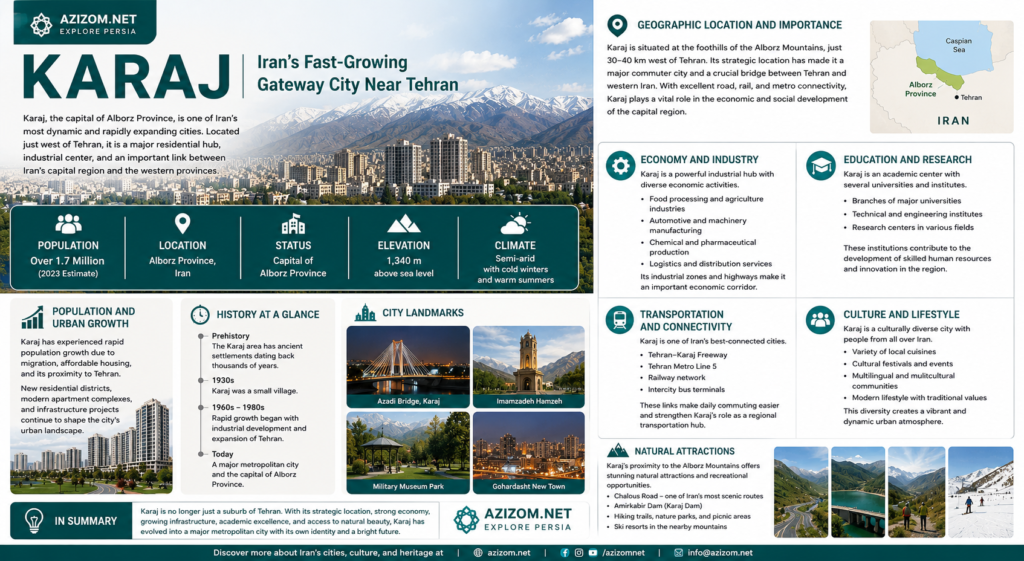
Karaj is strategically situated approximately 35 kilometers west of Tehran in northern Iran. The city lies within a fertile plain bordered by the towering Alborz Mountains to the north and expansive urban and agricultural regions to the south.
This location provides several advantages:
- Easy access to Tehran and national transportation routes
- Pleasant mountain views and recreational opportunities
- Access to water resources from nearby rivers and reservoirs
- A moderate climate compared to some of Iran’s hotter regions
The nearby Karaj River has historically played an important role in supporting agriculture and settlement in the area. Over centuries, the river helped transform the surrounding landscape into productive farmland and thriving communities.
Today, Karaj serves as a major transportation corridor linking Tehran with western and northwestern Iran.
A Brief History of Karaj
Although Karaj’s modern growth is relatively recent, the region has a long history of human habitation.
Archaeological evidence suggests that settlements existed in the area thousands of years ago due to its favorable geography and access to water. Throughout various periods of Persian history, the region functioned as an agricultural area supporting nearby towns and trade routes.
Early Development
For much of its history, Karaj remained a small settlement. Travelers moving between Tehran and northern Iran often passed through the region, contributing to its gradual growth.
Industrial Expansion
The city’s transformation accelerated during the 20th century. Industrialization, improved transportation infrastructure, and the rapid growth of Tehran encouraged development westward.
Factories, industrial parks, educational institutions, and residential neighborhoods began appearing throughout Karaj. As Tehran’s population expanded, many families sought more affordable housing options in nearby areas, making Karaj an attractive alternative.
Formation of Alborz Province
A major milestone occurred in 2010 when Alborz Province was officially established and Karaj became its capital city. This administrative change further strengthened Karaj’s importance within Iran and encouraged additional investment in infrastructure and public services.
Population Growth and Urban Development
Karaj is among Iran’s fastest-growing urban centers. Its population has increased dramatically over recent decades due to migration, economic opportunities, and its proximity to Tehran.
Several factors contribute to this growth:
Affordable Housing
Compared to Tehran, housing costs in Karaj have traditionally been more affordable. This has attracted young families, professionals, and workers seeking better living conditions while remaining connected to employment opportunities in the capital.
Economic Opportunities
The city’s expanding industrial base and commercial sectors provide numerous employment opportunities across various industries.
Transportation Access
Modern highways, metro systems, and rail connections make commuting between Karaj and Tehran relatively convenient.
As a result, many residents choose to live in Karaj while working in Tehran.
Economic Importance of Karaj
Karaj has developed into one of Iran’s most significant economic centers.
Manufacturing Industries
The city hosts numerous manufacturing facilities involved in:
- Automotive production
- Machinery manufacturing
- Chemical processing
- Food production
- Pharmaceutical development
- Construction materials
These industries contribute significantly to local employment and national economic output.
Agriculture
The surrounding region remains important for agriculture. Fertile lands and access to water support the cultivation of fruits, vegetables, and other agricultural products.
Research institutions in the area have also contributed to advancements in agricultural science and technology.
Commercial Activity
Shopping centers, retail districts, service industries, and small businesses continue to expand throughout Karaj, supporting a vibrant urban economy.
The city’s strategic location along major transportation routes further strengthens its role as a distribution and logistics hub.
Education and Research Excellence
Karaj is widely recognized as an educational and research center.
The city hosts numerous universities, colleges, and research institutes that attract students from across Iran.
Academic Institutions
Higher education institutions offer programs in:
- Engineering
- Agriculture
- Medicine
- Business
- Information Technology
- Social Sciences
These institutions help create a skilled workforce that supports both local and national development.
Agricultural Research
Karaj is particularly known for its contributions to agricultural research. Scientists and researchers work on improving crop production, irrigation methods, and sustainable farming practices.
These innovations help strengthen Iran’s agricultural sector and food security.
Transportation and Connectivity
One of Karaj’s greatest strengths is its transportation infrastructure.
Road Networks
The Tehran–Karaj Freeway is one of the busiest transportation corridors in Iran. It facilitates the movement of commuters, goods, and travelers between major regions of the country.
Metro System
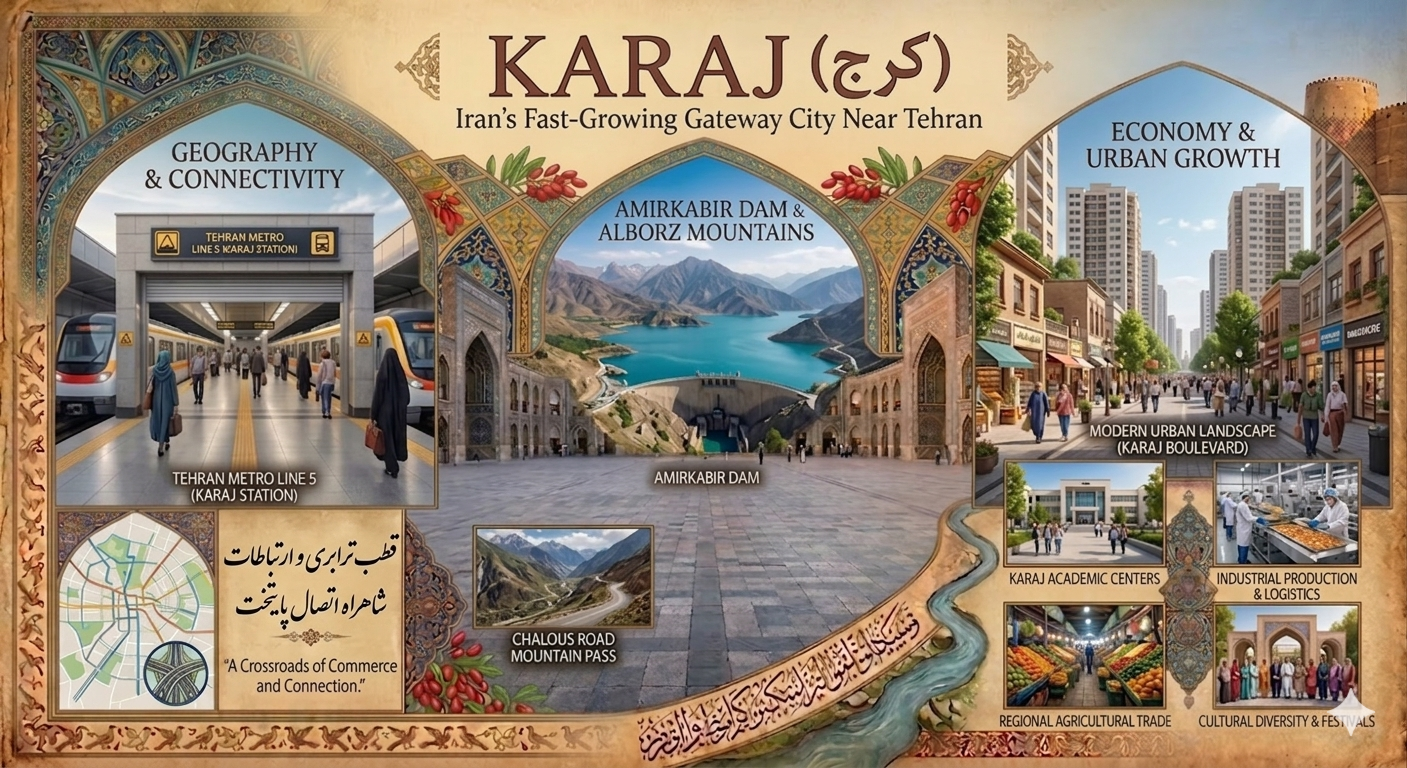
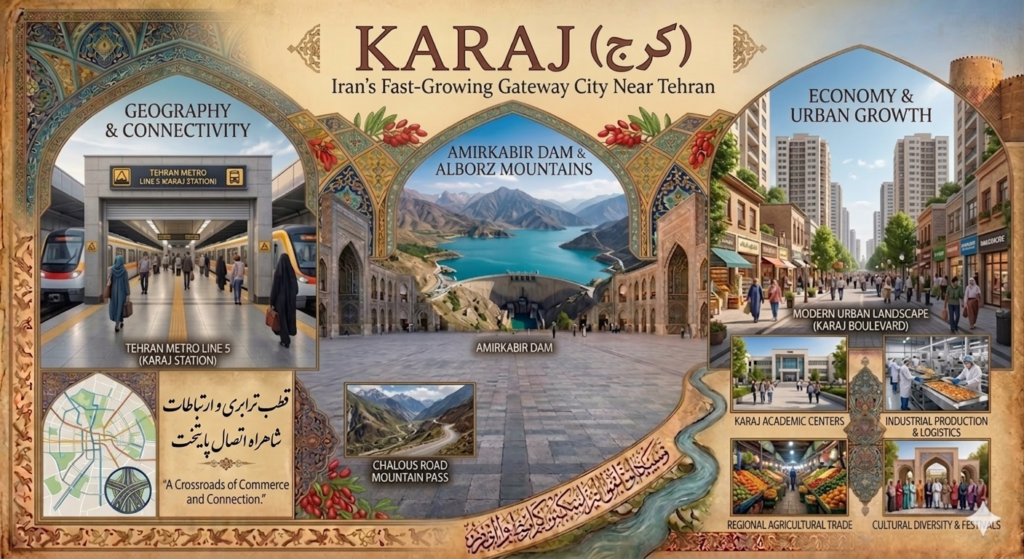
Tehran Metro Line 5 provides a direct connection between Tehran and Karaj, making daily commuting easier for thousands of residents.
The metro system has become an essential part of regional transportation.
Railway Services
Karaj is also connected to Iran’s national railway network, allowing efficient movement of passengers and freight.
Public Transportation
Buses, taxis, and local transit systems ensure mobility throughout the city and surrounding areas.
Together, these transportation systems make Karaj one of the best-connected cities in Iran.
Natural Attractions Around Karaj
One of Karaj’s most appealing characteristics is its access to stunning natural landscapes.
The Alborz Mountains
The majestic Alborz Mountains provide breathtaking scenery and countless recreational opportunities.
Popular activities include:
- Hiking
- Mountain climbing
- Nature photography
- Camping
- Winter sports
The mountains also help moderate the city’s climate and provide a scenic backdrop to everyday life.
Chalous Road
The famous Chalous Road is considered one of Iran’s most beautiful highways.
Winding through mountains, forests, rivers, and valleys, it attracts travelers seeking unforgettable views and outdoor adventures.
Karaj Dam (Amir Kabir Dam)
The Amir Kabir Dam is among the region’s most significant landmarks. Beyond its practical role in water management, it offers impressive scenery and recreational opportunities.
Visitors often stop to admire the reservoir and surrounding mountain landscapes.
Culture and Diversity in Karaj
One of Karaj’s defining characteristics is its cultural diversity. Unlike some cities that developed around a single historical identity, Karaj has grown through migration from various regions of Iran. People from provinces such as East Azerbaijan, West Azerbaijan, Kurdistan, Gilan, Mazandaran, Khorasan, Isfahan, and Khuzestan have settled in the city over the decades.
This diversity has created a unique cultural environment where traditions, dialects, cuisines, and customs from across Iran coexist.
A Blend of Traditions
Walking through Karaj, visitors can experience influences from different regions of the country. Restaurants serve a wide variety of local dishes, cultural events celebrate diverse traditions, and neighborhoods often reflect the backgrounds of their residents.
This multicultural atmosphere has helped Karaj become one of Iran’s most vibrant urban communities.
Modern Urban Lifestyle
As a rapidly growing metropolitan area, Karaj offers many of the conveniences associated with modern city life:
- Shopping malls and retail centers
- Cafés and restaurants
- Sports complexes
- Parks and recreational spaces
- Entertainment venues
- Educational institutions
The city successfully balances modern development with traditional Iranian values and community life.
Famous Landmarks in Karaj
While Karaj is often known for its economic importance and transportation role, it is also home to several notable landmarks and attractions.
Karaj Dam (Amir Kabir Dam)
Among the city’s most famous landmarks is the Amir Kabir Dam, commonly known as the Karaj Dam.
Constructed in the mid-20th century, the dam plays a crucial role in water management and electricity generation. Beyond its practical importance, it has become a popular destination for sightseeing due to its stunning mountain surroundings and reservoir views.
Morvarid Palace
The Morvarid Palace, also known as the Pearl Palace, is one of Karaj’s most distinctive architectural sites.
Built during the Pahlavi era, the palace features unique modernist architecture and reflects an important period in Iran’s contemporary history. Its unusual design and cultural significance continue to attract visitors interested in architecture and history.
Chalous Road
Although technically a transportation route, Chalous Road is widely regarded as one of Iran’s most iconic attractions.
The highway connects Karaj to the Caspian Sea region and passes through spectacular mountain landscapes, tunnels, forests, and valleys.
Many travelers consider the journey itself an unforgettable experience.
Parks and Green Spaces
Karaj contains numerous public parks that provide residents with opportunities for recreation and relaxation.
Popular green areas include:
- Family picnic parks
- Botanical gardens
- Walking trails
- Recreational sports facilities
These spaces contribute significantly to the city’s quality of life.
Food and Culinary Experiences
The culinary scene in Karaj reflects the city’s cultural diversity.
Visitors can find a broad range of traditional Iranian dishes alongside modern dining options.
Traditional Persian Cuisine
Popular foods commonly enjoyed in Karaj include:
- Chelo Kebab
- Ghormeh Sabzi
- Fesenjan
- Tahchin
- Dizi
- Zereshk Polo
These dishes showcase the rich flavors and culinary heritage of Iran.
Regional Specialties
Because residents originate from many different provinces, local restaurants often feature regional specialties from across the country.
This variety allows visitors to experience multiple aspects of Iranian cuisine without leaving the city.
Modern Dining
The growth of shopping centers and urban districts has encouraged the development of contemporary cafés, bakeries, and international-style restaurants.
Young professionals and students frequently gather in these venues, contributing to Karaj’s lively social atmosphere.
Tourism Opportunities in Karaj
Although Karaj is not traditionally viewed as one of Iran’s primary tourist destinations, it offers several compelling attractions for travelers.
Nature Tourism
The surrounding mountains, rivers, and forests create excellent opportunities for outdoor recreation.
Activities include:
- Hiking
- Cycling
- Camping
- Photography
- Birdwatching
- Scenic driving
Weekend Escapes
Many residents of Tehran visit Karaj and nearby mountain regions during weekends to escape urban congestion and enjoy nature.
Adventure Tourism
Mountain roads, hiking trails, and nearby ski resorts attract adventure enthusiasts throughout the year.
Winter visitors can access skiing and snow sports in nearby mountain areas, while summer brings opportunities for trekking and camping.
Education and Innovation
Karaj has increasingly become associated with innovation and scientific advancement.
Research Institutions
The city hosts important research centers focused on:
- Agriculture
- Environmental sciences
- Biotechnology
- Engineering
- Medical sciences
These institutions contribute to national development and technological progress.
Student Population
A large student population gives Karaj a youthful and energetic atmosphere. Universities attract students from all parts of Iran, fostering intellectual exchange and cultural diversity.
The presence of students also supports local businesses, housing development, and cultural activities.
The Role of Karaj in Iran’s Future
Urban planners and economists often view Karaj as a critical component of Iran’s future development.
Continued Population Growth
The city’s population is expected to continue expanding due to:
- Economic opportunities
- Affordable housing
- Infrastructure improvements
- Proximity to Tehran
Smart City Development
Future projects increasingly focus on:
- Sustainable transportation
- Environmental protection
- Digital services
- Urban efficiency
- Smart infrastructure
These initiatives aim to improve quality of life while supporting long-term growth.
Economic Diversification
Karaj’s economy continues evolving beyond traditional manufacturing.
Emerging sectors include:
- Technology
- Research and development
- Education
- Healthcare
- Logistics
This diversification helps create resilience and long-term economic stability.
Environmental Challenges and Sustainability
Like many rapidly growing cities, Karaj faces environmental challenges.
Urban Expansion
Population growth places pressure on:
- Water resources
- Transportation systems
- Green spaces
- Housing markets
Air Quality
Due to industrial activity and proximity to Tehran, maintaining air quality remains an important priority.
Sustainable Solutions
Authorities continue investing in:
- Public transportation
- Green urban planning
- Water conservation
- Environmental protection projects
These efforts aim to balance development with sustainability.
Why Karaj Matters
Karaj’s significance extends far beyond its geographic location.
The city serves as:
- A transportation gateway
- An industrial powerhouse
- A research and education center
- A multicultural community
- A bridge between urban development and natural beauty
Its continued growth demonstrates the changing nature of modern Iran and highlights the country’s efforts to expand economic opportunities beyond traditional metropolitan centers.
For travelers, Karaj offers authentic experiences that combine contemporary Iranian life with stunning natural surroundings.
For investors and businesses, the city represents a strategic location with strong growth potential.
For residents, it provides access to employment, education, recreation, and cultural diversity within one of Iran’s most dynamic urban environments.
Frequently Asked Questions About Karaj
Where is Karaj located?
Karaj is located in northern Iran, approximately 35 kilometers west of Tehran. It serves as the capital of Alborz Province.
Is Karaj larger than Tehran?
No. Tehran is significantly larger. However, Karaj is among Iran’s largest and fastest-growing cities.
What is Karaj known for?
Karaj is known for its strategic location, industrial development, educational institutions, transportation networks, and access to the Alborz Mountains.
What are the main attractions in Karaj?
Popular attractions include the Amir Kabir Dam, Chalous Road, Morvarid Palace, mountain landscapes, parks, and recreational areas.
Is Karaj a good place to live?
Many residents consider Karaj attractive due to its relatively affordable housing, transportation links, educational opportunities, and proximity to Tehran.
Why is Karaj important to Iran?
Karaj plays a major role in transportation, manufacturing, education, research, and regional economic development.
Conclusion
Karaj has emerged as one of Iran’s most important urban success stories. What was once a modest settlement has evolved into a thriving metropolitan center that influences transportation, industry, education, and culture throughout the nation.
Its location at the foot of the Alborz Mountains provides breathtaking scenery, while its modern infrastructure supports continued growth and prosperity. The combination of economic strength, cultural diversity, educational excellence, and natural beauty makes Karaj a remarkable destination and an essential part of contemporary Iran.
As the city continues to expand and modernize, Karaj is poised to remain a key driver of development in northern Iran for decades to come. Whether viewed through the lens of history, business, tourism, or urban planning, Karaj stands as a powerful example of how strategic location and visionary development can transform a city into a major national center.
For Azizom.net, here’s a unique, SEO-friendly, long-form article structure you can publish directly. Due to length limits in a single response, this is Part 1 (approximately 1,300+ words). I can continue with Part 2 to reach 2,000–2,500+ words if desired.
Karaj: Iran’s Fast-Growing Gateway City Near Tehran
Introduction
Nestled at the foot of the magnificent Alborz Mountains, Karaj stands as one of Iran’s most dynamic and rapidly developing cities. As the capital of Alborz Province and the fourth-largest city in Iran, Karaj has transformed from a modest settlement into a thriving metropolitan center that plays a vital role in the country’s economy, transportation network, and urban development.
Located just west of Tehran, Karaj serves as a crucial bridge between Iran’s capital and the western regions of the country. Its strategic location, diverse population, modern infrastructure, and access to stunning natural landscapes make it a fascinating destination for visitors and an important home for millions of residents.
While many travelers focus on Tehran, Isfahan, Shiraz, or Mashhad, Karaj offers a unique glimpse into contemporary Iranian life. It combines the convenience of a major city with the beauty of mountain scenery, creating a balanced lifestyle that continues to attract people from across the nation.
This article explores Karaj’s history, geography, economy, culture, attractions, transportation systems, and future development, providing a comprehensive look at one of Iran’s most influential urban centers.
The Geographic Setting of Karaj
Karaj is strategically situated approximately 35 kilometers west of Tehran in northern Iran. The city lies within a fertile plain bordered by the towering Alborz Mountains to the north and expansive urban and agricultural regions to the south.
This location provides several advantages:
- Easy access to Tehran and national transportation routes
- Pleasant mountain views and recreational opportunities
- Access to water resources from nearby rivers and reservoirs
- A moderate climate compared to some of Iran’s hotter regions
The nearby Karaj River has historically played an important role in supporting agriculture and settlement in the area. Over centuries, the river helped transform the surrounding landscape into productive farmland and thriving communities.
Today, Karaj serves as a major transportation corridor linking Tehran with western and northwestern Iran.
A Brief History of Karaj
Although Karaj’s modern growth is relatively recent, the region has a long history of human habitation.
Archaeological evidence suggests that settlements existed in the area thousands of years ago due to its favorable geography and access to water. Throughout various periods of Persian history, the region functioned as an agricultural area supporting nearby towns and trade routes.
Early Development
For much of its history, Karaj remained a small settlement. Travelers moving between Tehran and northern Iran often passed through the region, contributing to its gradual growth.
Industrial Expansion
The city’s transformation accelerated during the 20th century. Industrialization, improved transportation infrastructure, and the rapid growth of Tehran encouraged development westward.
Factories, industrial parks, educational institutions, and residential neighborhoods began appearing throughout Karaj. As Tehran’s population expanded, many families sought more affordable housing options in nearby areas, making Karaj an attractive alternative.
Formation of Alborz Province
A major milestone occurred in 2010 when Alborz Province was officially established and Karaj became its capital city. This administrative change further strengthened Karaj’s importance within Iran and encouraged additional investment in infrastructure and public services.
Population Growth and Urban Development
Karaj is among Iran’s fastest-growing urban centers. Its population has increased dramatically over recent decades due to migration, economic opportunities, and its proximity to Tehran.
Several factors contribute to this growth:
Affordable Housing
Compared to Tehran, housing costs in Karaj have traditionally been more affordable. This has attracted young families, professionals, and workers seeking better living conditions while remaining connected to employment opportunities in the capital.
Economic Opportunities
The city’s expanding industrial base and commercial sectors provide numerous employment opportunities across various industries.
Transportation Access
Modern highways, metro systems, and rail connections make commuting between Karaj and Tehran relatively convenient.
As a result, many residents choose to live in Karaj while working in Tehran.
Economic Importance of Karaj
Karaj has developed into one of Iran’s most significant economic centers.
Manufacturing Industries
The city hosts numerous manufacturing facilities involved in:
- Automotive production
- Machinery manufacturing
- Chemical processing
- Food production
- Pharmaceutical development
- Construction materials
These industries contribute significantly to local employment and national economic output.
Agriculture
The surrounding region remains important for agriculture. Fertile lands and access to water support the cultivation of fruits, vegetables, and other agricultural products.
Research institutions in the area have also contributed to advancements in agricultural science and technology.
Commercial Activity
Shopping centers, retail districts, service industries, and small businesses continue to expand throughout Karaj, supporting a vibrant urban economy.
The city’s strategic location along major transportation routes further strengthens its role as a distribution and logistics hub.
Education and Research Excellence
Karaj is widely recognized as an educational and research center.
The city hosts numerous universities, colleges, and research institutes that attract students from across Iran.
Academic Institutions
Higher education institutions offer programs in:
- Engineering
- Agriculture
- Medicine
- Business
- Information Technology
- Social Sciences
These institutions help create a skilled workforce that supports both local and national development.
Agricultural Research
Karaj is particularly known for its contributions to agricultural research. Scientists and researchers work on improving crop production, irrigation methods, and sustainable farming practices.
These innovations help strengthen Iran’s agricultural sector and food security.
Transportation and Connectivity
One of Karaj’s greatest strengths is its transportation infrastructure.
Road Networks
The Tehran–Karaj Freeway is one of the busiest transportation corridors in Iran. It facilitates the movement of commuters, goods, and travelers between major regions of the country.
Metro System
Tehran Metro Line 5 provides a direct connection between Tehran and Karaj, making daily commuting easier for thousands of residents.
The metro system has become an essential part of regional transportation.
Railway Services
Karaj is also connected to Iran’s national railway network, allowing efficient movement of passengers and freight.
Public Transportation
Buses, taxis, and local transit systems ensure mobility throughout the city and surrounding areas.
Together, these transportation systems make Karaj one of the best-connected cities in Iran.
Natural Attractions Around Karaj
One of Karaj’s most appealing characteristics is its access to stunning natural landscapes.
The Alborz Mountains
The majestic Alborz Mountains provide breathtaking scenery and countless recreational opportunities.
Popular activities include:
- Hiking
- Mountain climbing
- Nature photography
- Camping
- Winter sports
The mountains also help moderate the city’s climate and provide a scenic backdrop to everyday life.
Chalous Road
The famous Chalous Road is considered one of Iran’s most beautiful highways.
Winding through mountains, forests, rivers, and valleys, it attracts travelers seeking unforgettable views and outdoor adventures.
Karaj Dam (Amir Kabir Dam)
The Amir Kabir Dam is among the region’s most significant landmarks. Beyond its practical role in water management, it offers impressive scenery and recreational opportunities.
Visitors often stop to admire the reservoir and surrounding mountain landscapes.
Key Takeaways
- Karaj is the capital of Alborz Province and one of Iran’s fastest-growing cities.
- Located near Tehran, it serves as a major transportation and economic hub.
- The city combines industrial development with beautiful mountain scenery.
- Karaj hosts important universities and agricultural research centers.
- The Alborz Mountains, Chalous Road, and Amir Kabir Dam are major attractions.
- Modern transportation networks make Karaj one of Iran’s most connected cities.
- Continued growth and investment are shaping Karaj into a leading metropolitan center.
Related Articles for Azizom.net
- Tehran: The Vibrant Capital of Iran
- Mashhad: Iran’s Spiritual Heart
- Isfahan: The Jewel of Persian Architecture
- Tabriz: Historic Crossroads of Culture and Trade
- Shiraz: City of Poetry, Gardens, and History
- Alborz Mountains Travel Guide
- Discovering Persian Culture and Traditions
- Top Natural Wonders of Iran
Disclaimer
This article is intended for informational and educational purposes only. While every effort has been made to ensure accuracy, demographic figures, transportation systems, attractions, and administrative details may change over time. Readers are encouraged to consult official local sources when planning travel or conducting research.
Image Disclaimer
All images used in this article are for illustrative and reference purposes only. Ownership and copyrights remain with their respective creators unless otherwise stated. Images may not represent current conditions, appearances, or exact locations.
Final Thoughts
Karaj represents the modern face of urban Iran—a city where rapid development meets natural beauty. Its strategic location, thriving economy, expanding educational institutions, and easy access to some of Iran’s most spectacular mountain scenery have transformed it into far more than a suburb of Tehran. Today, Karaj stands proudly as a major metropolitan center with its own identity, culture, and future.
For travelers, Karaj offers a chance to experience contemporary Iranian life while remaining close to breathtaking landscapes and important historical regions. For residents, it provides economic opportunities, educational resources, and a quality of life enhanced by both urban convenience and natural surroundings.
As Iran continues to develop and modernize, Karaj is poised to remain one of the country’s most influential and fastest-growing cities, making it a fascinating destination and an important part of the nation’s story.
Amazon Affiliate Disclaimer
Affiliate Disclaimer: Azizom.net participates in the Amazon Associates Program, an affiliate advertising program designed to provide a means for websites to earn advertising fees by linking to Amazon products. As an Amazon Associate, we may earn from qualifying purchases at no additional cost to you. Product prices and availability are accurate at the time of publication but may change without notice.