Discover the Breath taking Green Capital of Northern Iran’s Natural Wonders
Published by Azizom.net
Introduction
Nestled between the majestic Alborz Mountains and the shimmering shores of the Caspian Sea, Sari stands as one of Iran’s oldest and most beautiful cities. As the capital of Mazandaran Province, Sari is renowned for its lush forests, fertile agricultural lands, rich cultural heritage, and easy access to some of the most breathtaking natural attractions in northern Iran.
Unlike many large urban centers that have become dominated by modern development, Sari has managed to preserve its close relationship with nature. The city is surrounded by dense forests, rolling hills, rivers, wetlands, and agricultural fields that create a landscape unlike anywhere else in the country.
For centuries, travelers, traders, and settlers have been drawn to this fertile region. Today, Sari continues to attract visitors seeking authentic Iranian culture, spectacular scenery, traditional cuisine, and outdoor adventures. Whether exploring ancient forests, relaxing by the Caspian coastline, or discovering local traditions, visitors quickly understand why Sari is often called the Green Capital of Northern Iran.
Where Is Sari Located?
Sari is located in northern Iran and serves as the administrative center of Mazandaran Province. The city’s unique geographical location places it between two of Iran’s most important natural features:
- The Caspian Sea to the north
- The Alborz Mountain Range to the south
This positioning gives Sari a mild and humid climate that differs significantly from the arid conditions found in much of central and southern Iran.
The surrounding region features:
- Dense forests
- Rice paddies
- Citrus orchards
- Rivers and streams
- Mountain valleys
- Coastal plains
The natural abundance of water and fertile soil has made the area one of Iran’s most productive agricultural regions for thousands of years.
Because of its location, Sari serves as an important transportation and economic hub connecting northern Iran with Tehran and other major cities.
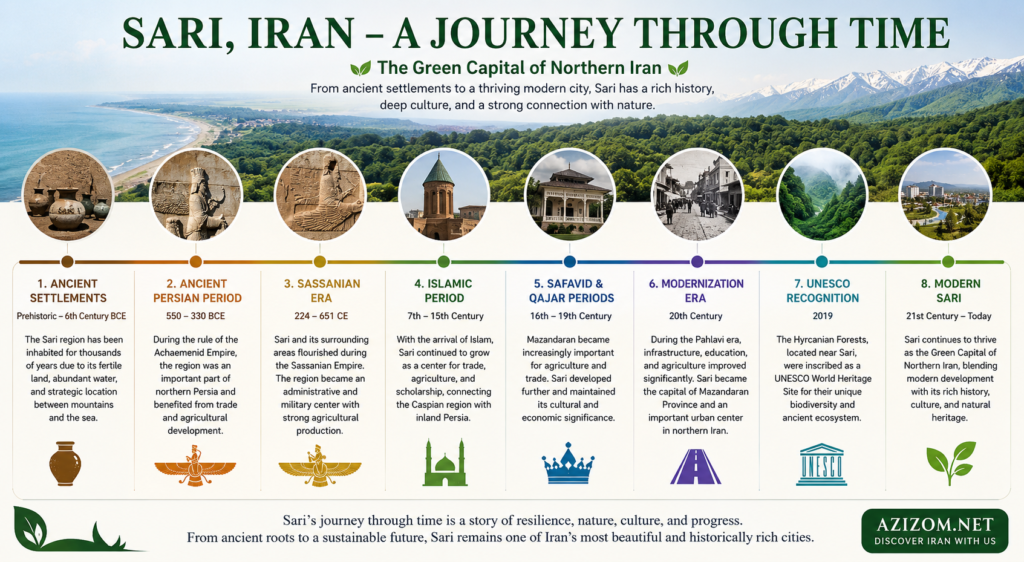
The Ancient History of Sari
Sari is considered one of the oldest continuously inhabited cities in Iran. Historical evidence suggests that human settlement in the area dates back thousands of years.
Throughout history, the region has witnessed the rise and fall of numerous civilizations and empires.
Ancient Persia
The area around Sari was inhabited long before the formation of the Persian Empire. Ancient tribes settled in the fertile Caspian region, benefiting from abundant natural resources and favorable climate conditions.
The region played a strategic role due to its position between mountain routes and coastal trade networks.
Sassanian Era
During the Sassanian Empire (224–651 CE), the area became an important administrative and military center.
The surrounding mountains provided natural protection, while the fertile lands supported agriculture and local economies.
Many historians believe the city expanded significantly during this period.
Islamic Period
Following the arrival of Islam in Persia, Sari continued to flourish as a center of trade, agriculture, and scholarship.
The city’s location allowed merchants to transport goods between the Caspian region and interior Persia, strengthening economic ties throughout the region.
Safavid and Qajar Periods
Under the Safavid and later Qajar dynasties, Mazandaran gained increasing importance due to its agricultural wealth and strategic coastal location.
Sari developed into a significant provincial center while maintaining its traditional cultural identity.
Today, visitors can still discover traces of the city’s long and fascinating history throughout the region.
The Hyrcanian Forests: A Living Natural Treasure
One of Sari’s greatest attractions is its proximity to the extraordinary Hyrcanian Forests.
These forests are among the oldest surviving forests on Earth and represent a rare ecosystem that has existed for millions of years.
Stretching along the southern coast of the Caspian Sea, the Hyrcanian Forests have been recognized as a UNESCO World Heritage Site due to their global ecological importance.
Why Are the Hyrcanian Forests Special?
Scientists estimate that parts of these forests are more than 25 million years old.
They survived multiple ice ages and continue to support unique plant and animal species that cannot be found elsewhere.
The forests contain:
- Ancient broadleaf trees
- Rare plant species
- Rich biodiversity
- Protected wildlife habitats
- Mountain ecosystems
Walking through these forests feels like stepping into a prehistoric world where nature has remained largely unchanged for countless generations.
Wildlife of the Region
The Hyrcanian ecosystem supports a remarkable variety of wildlife, including:
- Persian leopards
- Wild boars
- Brown bears
- Wolves
- Deer species
- Numerous bird species
Conservation efforts continue to protect this irreplaceable natural heritage for future generations.
Exploring the Caspian Sea Coastline
One of the major advantages of visiting Sari is its easy access to the Caspian Sea.
The Caspian Sea is the world’s largest inland body of water and serves as one of northern Iran’s most popular tourism destinations.
Visitors can enjoy:
- Sandy beaches
- Coastal parks
- Fishing communities
- Waterfront resorts
- Recreational activities
- Scenic sunsets
The combination of sea, forest, and mountain landscapes creates an extraordinary variety of experiences within a relatively short distance.
Unlike the hot southern coastlines of the Persian Gulf, the Caspian region enjoys milder temperatures and lush greenery, making it especially attractive during spring and summer.
Badab-e Surt: Iran’s Natural Wonder
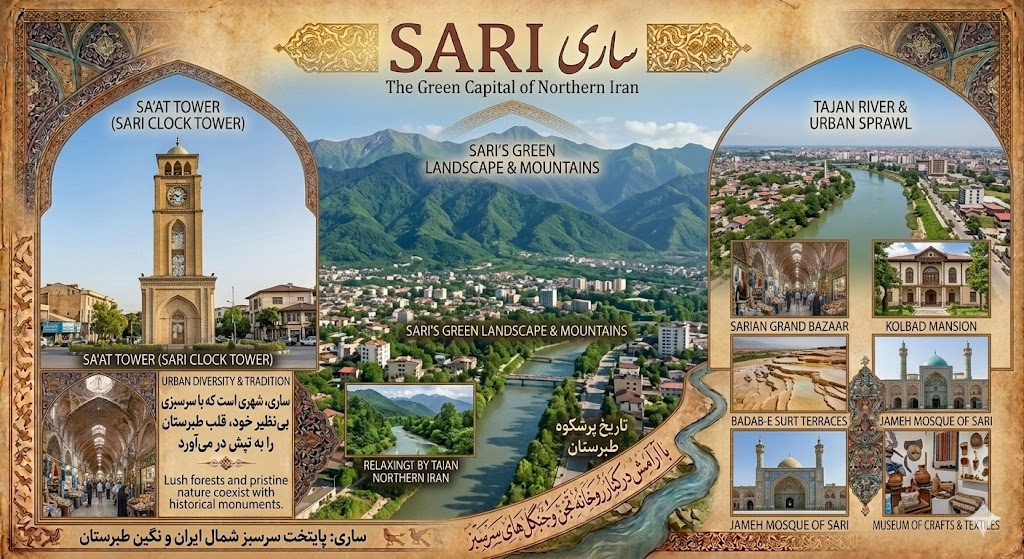
Among the most spectacular natural attractions near Sari is the famous Badab-e Surt.
Often described as one of Iran’s most unique geological formations, Badab-e Surt consists of colorful mineral terraces created by natural springs over thousands of years.
What Makes Badab-e Surt Unique?
The site features:
- Natural travertine terraces
- Mineral-rich springs
- Orange, red, yellow, and gold colors
- Stunning mountain views
- Unique geological formations
The mineral deposits have gradually formed layered pools that create an incredible visual landscape.
As sunlight changes throughout the day, the colors of the terraces shift dramatically, making the location a favorite destination for photographers and nature enthusiasts.
Many travelers compare Badab-e Surt to famous travertine terraces found in other parts of the world, yet its distinctive Iranian setting makes it truly unique.
Culture and Traditions of Sari
Sari is a cultural heartland of the Mazandarani people, whose traditions have been preserved for centuries.
The region possesses a strong cultural identity that differs in many ways from other parts of Iran.
Language and Heritage
In addition to Persian, many residents speak Mazandarani, one of Iran’s historic regional languages.
This linguistic heritage reflects the region’s long history and cultural independence.
Traditional Music
Music remains an important part of local life.
Mazandarani folk music often features:
- Traditional instruments
- Storytelling songs
- Harvest celebrations
- Wedding performances
- Community festivals
The melodies frequently draw inspiration from nature, rural life, and regional history.
Festivals and Celebrations
Seasonal festivals continue to celebrate agricultural traditions, local customs, and cultural identity.
These gatherings provide visitors with opportunities to experience authentic northern Iranian hospitality and traditions.
The Culinary Delights of Sari
Northern Iranian cuisine is widely considered among the finest in the country.
The fertile environment surrounding Sari provides fresh ingredients from forests, rivers, farms, and the sea.
Mirza Ghasemi
One of the region’s most beloved dishes, Mirza Ghasemi combines:
- Smoked eggplant
- Tomatoes
- Garlic
- Eggs
Its smoky flavor has made it popular throughout Iran.
Baghala Ghatogh
This traditional dish consists of:
- Fava beans
- Garlic
- Herbs
- Eggs
It remains a staple of Mazandarani cuisine.
Fresh Fish and Seafood
The Caspian Sea contributes a variety of seafood dishes, including:
- Grilled fish
- Smoked fish
- Fish stews
- Traditional seafood specialties
Rice-Based Dishes
Mazandaran is famous for producing high-quality rice.
As a result, rice serves as the foundation of many local meals.
Combined with fresh herbs, vegetables, and seafood, these dishes create unforgettable culinary experiences.
Agriculture: The Backbone of the Region
Agriculture plays a central role in Sari’s economy and identity.
The region’s fertile lands support some of Iran’s most productive farming operations.
Key agricultural products include:
- Rice
- Citrus fruits
- Tea
- Vegetables
- Wheat
- Livestock products
The extensive rice fields surrounding the city create beautiful landscapes while supporting local livelihoods.
Citrus orchards are especially important, producing oranges, lemons, and tangerines that are distributed throughout Iran.
Ecotourism and Outdoor Activities
Nature lovers will find countless opportunities for exploration around Sari.
Popular outdoor activities include:
Forest Hiking
The nearby forests offer trails suitable for both casual walkers and experienced hikers.
Mountain Adventures
The Alborz Mountains provide:
- Hiking routes
- Camping opportunities
- Scenic viewpoints
- Wildlife observation
Bird Watching
Wetlands and forests attract numerous migratory and native bird species.
Bird enthusiasts frequently visit the region throughout the year.
Photography
The diversity of landscapes makes Sari one of Iran’s best destinations for photography.
Visitors can capture:
- Forest scenery
- Coastal views
- Mountain landscapes
- Traditional villages
- Wildlife
- Agricultural fields
Best Time to Visit Sari
Sari can be visited year-round, but some seasons offer particularly memorable experiences.
Spring (March–May)
Spring is widely regarded as the ideal season.
Visitors can enjoy:
- Blooming flowers
- Green forests
- Pleasant temperatures
- Clear scenery
Summer (June–August)
Summer attracts beachgoers and nature lovers.
The forests provide welcome shade and cooler temperatures compared to central Iran.
Autumn (September–November)
Autumn transforms the forests into vibrant displays of red, orange, and gold.
This season is especially popular among photographers.
Winter (December–February)
While cooler and wetter, winter offers peaceful landscapes and fewer crowds.
Snow-covered mountain views can be particularly beautiful.
Why Sari Should Be on Every Traveler’s List
Sari offers an exceptional combination of attractions rarely found in a single destination.
Visitors can experience:
- Ancient history
- UNESCO-listed forests
- Caspian Sea coastlines
- Traditional villages
- Local cuisine
- Cultural heritage
- Ecotourism adventures
- Geological wonders
The city’s balance between natural beauty and cultural richness creates an unforgettable travel experience.
Whether exploring forests that predate human civilization or enjoying fresh seafood by the Caspian Sea, travelers discover a side of Iran that remains largely unknown to the wider world.
Key Facts About Sari
| Feature | Information |
|---|---|
| Province | Mazandaran |
| Region | Northern Iran |
| Capital Status | Capital of Mazandaran Province |
| Famous For | Forests, Nature, Agriculture |
| UNESCO Attraction | Hyrcanian Forests |
| Nearby Landmark | Badab-e Surt |
| Major Economy | Agriculture & Tourism |
| Natural Features | Caspian Sea, Forests, Mountains |
| Best Seasons | Spring & Autumn |
Key Takeaways
- Sari is one of Iran’s oldest cities and the capital of Mazandaran Province.
- The city is located between the Caspian Sea and the Alborz Mountains.
- The UNESCO-listed Hyrcanian Forests are among the region’s greatest treasures.
- Badab-e Surt is one of Iran’s most spectacular natural attractions.
- Agriculture, tourism, and forestry are key economic sectors.
- Sari is famous for traditional Mazandarani culture and cuisine.
- The city offers excellent opportunities for ecotourism and outdoor adventures.
- Spring and autumn are considered the best times to visit.
Related Articles on Azizom.net
If you enjoyed learning about Sari, you may also like:
- Mashhad – Iran’s Spiritual Capital
- Kerman – The Desert Jewel of Iran
- Kermanshah – The Historic Heart of Western Iran
- Arak – The Industrial Heart of Central Iran
- Zahedan – Gateway to Southeast Iran
- Discovering the Caspian Sea Coast of Iran
- UNESCO World Heritage Sites in Iran
- The Ancient Forests of Northern Iran
Final Thoughts
Sari stands among the most captivating destinations in northern Iran. Its remarkable blend of ancient history, lush forests, fertile farmland, cultural traditions, and natural wonders makes it a destination unlike any other.
From wandering through the ancient Hyrcanian Forests and witnessing the colorful terraces of Badab-e Surt to enjoying traditional Mazandarani cuisine and relaxing along the Caspian coastline, visitors are rewarded with experiences that showcase the extraordinary diversity of Iran.
For travelers seeking authenticity, natural beauty, cultural depth, and unforgettable landscapes, Sari represents one of the finest destinations in the country and a true jewel of northern Iran.
As tourism continues to grow in the region, Sari remains a shining example of how history, nature, and culture can coexist to create a destination that inspires visitors from around the world.
Disclaimer
Travel Information Disclaimer:
The information provided in this article is intended for general educational and travel purposes only. Attractions, transportation services, entry requirements, opening hours, and local regulations may change over time. Visitors should verify current information through official sources before making travel arrangements.Historical and Cultural Disclaimer:
Historical references are based on publicly available sources and scholarly interpretations. Dates, events, and historical narratives may vary among researchers and historical records.Nature and Outdoor Activities Disclaimer:
Natural attractions, hiking routes, forests, mountains, and coastal areas may present risks due to weather, terrain, wildlife, or changing environmental conditions. Travelers should take appropriate safety precautions and follow local guidance.Image Disclaimer:
Any images used alongside this article are for illustrative and informational purposes only. Copyright remains with their respective owners unless otherwise stated. Azizom.net does not claim ownership of third-party images used under applicable licenses or permissions.Affiliate Disclosure:
Some pages on Azizom.net may contain amazon associate affiliate links. If readers purchase products or services through such links, Azizom.net may earn a commission at no additional cost to the buyer.Content Disclaimer:
While every effort is made to ensure accuracy, Azizom.net makes no guarantees regarding the completeness, reliability, or current accuracy of the information presented in this article.
Source: Azizom.net – Exploring Iran’s Cities, Culture, History, and Natural Wonders.