Exploring Abadan, Iran: History, Culture, Food and Landmarks
Introduction
Nestled in the southwestern corner of Iran, where the mighty Arvand River flows toward the Persian Gulf, lies one of the country’s most fascinating cities: Abadan. Often referred to as the “Pearl of the Persian Gulf” and recognized as Iran’s historic oil capital, Abadan has played a crucial role in shaping the nation’s economic, industrial, and cultural identity.
For more than a century, Abadan has stood at the crossroads of commerce, energy production, international trade, and cultural exchange. While its oil refinery brought global attention to the city, Abadan’s story extends far beyond petroleum. It is a city of resilience, rich traditions, diverse communities, unique cuisine, and a remarkable ability to rebuild and reinvent itself.
Today, visitors who explore Abadan discover a city where history meets modern industry, where rivers connect cultures, and where the spirit of southern Iran shines brightly.
The Geographic Significance of Abadan
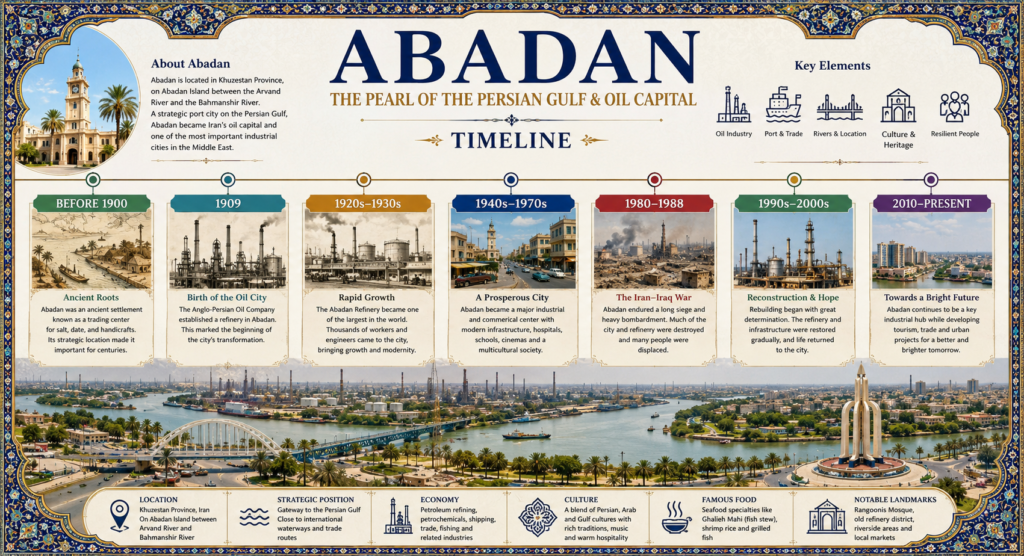
Abadan is situated in Khuzestan Province on Abadan Island, an area formed by the Arvand River and the Bahmanshir River. This strategic location places the city close to both Iraq and the Persian Gulf, making it one of Iran’s most important transportation and maritime centers.
Throughout history, waterways have served as lifelines for Abadan. The city’s rivers facilitated trade, fishing, transportation, and cultural exchange long before oil transformed the region. Even today, riverfront areas remain among the city’s most attractive locations, offering beautiful scenery and a glimpse into everyday life.
Its proximity to international shipping routes has also contributed significantly to Abadan’s economic importance. Goods, people, and ideas have passed through the region for centuries, helping shape its multicultural identity.
Ancient Roots and Early History
Although Abadan is most famous for its oil industry, its origins stretch much further back in time.
Historical records suggest that settlements existed in the area for centuries due to its advantageous location along trade routes connecting Mesopotamia, Persia, and the Gulf region. Merchants, fishermen, and travelers frequently passed through the area, contributing to its development as a local trading center.
Various dynasties and empires recognized the value of the region. Over time, the city’s fortunes rose and fell as political boundaries shifted and regional powers competed for control of strategic waterways.
Despite these changes, the area remained inhabited and economically active, laying the foundation for the modern city that would emerge in the twentieth century.
The Discovery of Oil and a New Era
The turning point in Abadan’s history arrived with the discovery of oil in southwestern Iran during the early 1900s.
As global demand for petroleum increased, international attention focused on Khuzestan Province. The establishment of the Abadan Refinery transformed the city almost overnight. What had once been a modest settlement rapidly evolved into a bustling industrial center.
Workers, engineers, entrepreneurs, and specialists arrived from across Iran and around the world. New neighborhoods were constructed, infrastructure expanded, and modern facilities emerged at an unprecedented pace.
Abadan soon became one of the most important oil cities in the world.
The refinery’s influence extended beyond economics. It introduced modern urban planning concepts, educational institutions, recreational facilities, and healthcare services that were rare in many parts of the region at the time.
For decades, Abadan symbolized modernization and industrial progress in Iran.
The World’s Largest Refinery
By the mid-twentieth century, the Abadan Refinery had achieved global recognition.
At one point, it ranked among the largest oil refineries on Earth, processing enormous quantities of crude oil and supplying fuel to international markets. Its output helped power industries, transportation networks, and economies across multiple continents.
The refinery became more than an industrial facility—it became the heart of the city.
Entire communities developed around refinery operations. Housing complexes, schools, sports clubs, cultural centers, and social institutions emerged to support workers and their families.
This period brought prosperity and growth, establishing Abadan as a major urban center within Iran and the wider Middle East.
A Multicultural City
One of Abadan’s most distinctive characteristics is its cultural diversity.
Due to its strategic location and industrial importance, people from many backgrounds settled in the city. Persian, Arab, and other regional influences blended together to create a unique local identity.
Visitors often notice this diversity through:
- Language and dialects
- Traditional clothing
- Music and dance
- Culinary traditions
- Religious and cultural celebrations
The result is a vibrant social environment that distinguishes Abadan from many other Iranian cities.
Local residents are renowned for their hospitality, generosity, and strong sense of community. These qualities remain among the city’s defining characteristics today.
Abadan During the Iran-Iraq War
The Iran-Iraq War marked one of the most challenging chapters in Abadan’s history.
Because of its proximity to the border and its strategic importance, the city became a major target during the conflict. Heavy fighting, bombardments, and a prolonged siege caused extensive damage to infrastructure, residential areas, and industrial facilities.
Thousands of residents were displaced as the conflict intensified.
Yet despite these hardships, Abadan became a symbol of courage and resistance. The determination shown by its people during this difficult period remains deeply respected throughout Iran.
Stories of sacrifice, endurance, and resilience continue to be passed down through generations, forming an important part of the city’s collective memory.
Reconstruction and Renewal
Following the end of the war, Abadan faced the enormous challenge of rebuilding.
Reconstruction efforts focused on restoring homes, public services, transportation networks, and industrial facilities. The refinery underwent extensive repairs and modernization programs to resume operations.
Over time, residents returned, businesses reopened, and new investments helped revive economic activity.
The city’s recovery demonstrated remarkable perseverance and highlighted the determination of its people to rebuild their lives and preserve their community.
Today, visitors can still find reminders of this historical period, but they are equally likely to encounter signs of progress, modernization, and optimism.
The Economy of Modern Abadan
Although petroleum remains central to the local economy, modern Abadan has diversified significantly.
Key economic sectors include:
Oil and Petrochemicals
The energy industry continues to provide employment and investment opportunities while supporting national economic development.
Shipping and Maritime Trade
The city’s access to international waterways supports commercial shipping and logistics operations.
Fishing Industry
Abadan’s location near rivers and the Persian Gulf sustains a thriving fishing sector that contributes to local livelihoods.
Retail and Services
Growing commercial districts support local businesses and provide services for residents and visitors.
Tourism
Historical landmarks, cultural attractions, and riverfront areas increasingly attract domestic and international travelers.
Famous Landmarks in Abadan
Abadan offers visitors a variety of attractions that reflect its rich heritage.
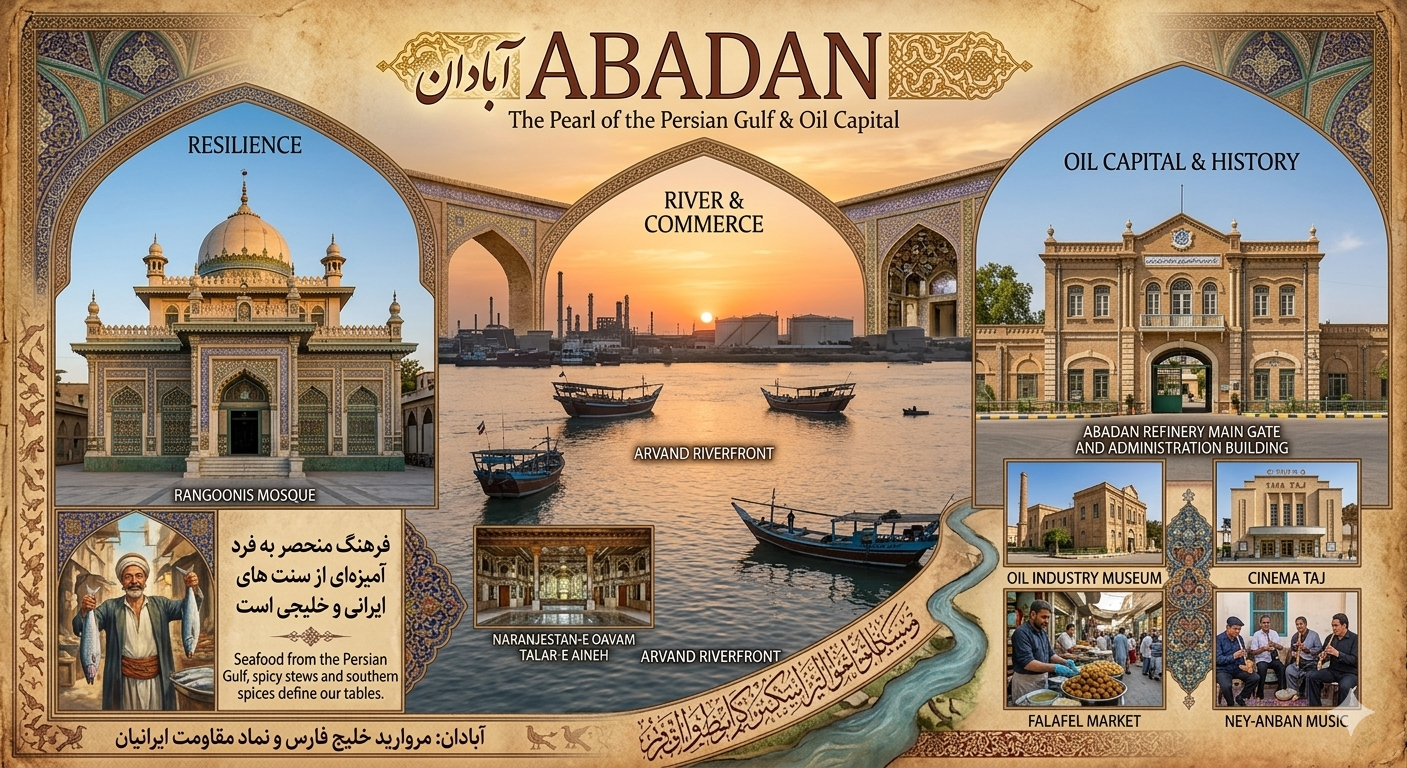
Rangoonis Mosque
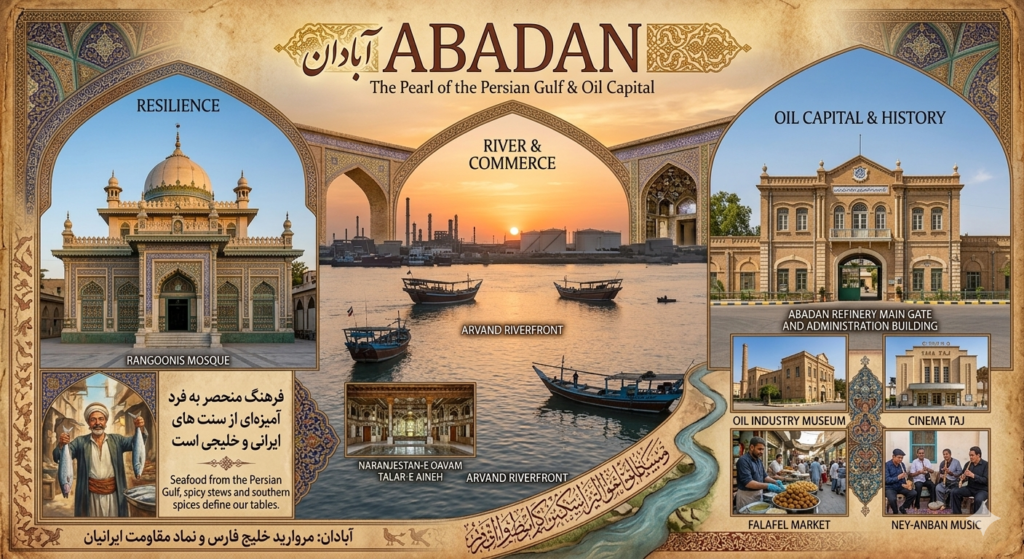
One of the city’s most recognized landmarks, the Rangoonis Mosque showcases unique architectural influences and historical significance. Its distinctive design makes it a favorite destination for photographers and history enthusiasts.
Abadan Refinery District
Although industrial in nature, the refinery district represents a significant chapter in global energy history and remains closely connected to the city’s identity.
Arvand River Waterfront
The waterfront provides beautiful views, particularly during sunrise and sunset. Residents often gather here to relax, socialize, and enjoy the refreshing river breeze.
Traditional Markets
Local bazaars offer opportunities to experience authentic southern Iranian culture, purchase regional products, and sample local cuisine.
The Flavors of Abadan
Food plays an essential role in Abadan’s cultural identity.
Influenced by Persian, Arab, and Gulf traditions, local cuisine is famous for its bold flavors and generous use of spices.
Popular dishes include:
Ghalieh Mahi
A spicy fish stew prepared with herbs, tamarind, and local seasonings.
Shrimp Rice
A beloved southern specialty featuring fragrant rice and freshly caught shrimp.
Grilled Fish
Fresh seafood cooked over open flames remains a favorite among residents and visitors alike.
Local Dates
Khuzestan Province produces high-quality dates that are widely enjoyed throughout the region.
The city’s culinary scene reflects its coastal heritage and multicultural character.
Climate and Best Time to Visit
Abadan experiences a hot desert climate characterized by long, warm summers and mild winters.
The most comfortable months for tourism are generally:
- November
- December
- January
- February
- March
During these months, temperatures are more pleasant for sightseeing and outdoor activities.
Visitors planning a summer trip should prepare for extremely high temperatures and stay hydrated.
Why Abadan Matters Today
Abadan remains one of Iran’s most historically significant cities.
Its influence extends across multiple areas:
- Energy production
- Industrial development
- Maritime commerce
- Cultural diversity
- National history
The city serves as a reminder of how geography, natural resources, and human determination can shape the destiny of a region.
As Iran continues to modernize and expand its economic opportunities, Abadan remains an important contributor to national development.
Preserving Heritage While Building the Future
Modern cities often face the challenge of balancing progress with preservation.
Abadan is no exception.
Local authorities, historians, and community organizations continue working to protect historical landmarks and cultural traditions while supporting modernization initiatives.
Efforts to improve infrastructure, expand tourism, and encourage investment are helping create new opportunities for future generations.
The city’s unique blend of history and innovation makes it one of Iran’s most compelling urban destinations.
Final Thoughts
Abadan’s story is one of transformation, perseverance, and pride. From its early days as a riverside settlement to its rise as a global oil powerhouse, the city has repeatedly adapted to changing circumstances while maintaining its distinctive identity.
Today, Abadan stands as more than just Iran’s oil capital. It is a living testament to resilience, cultural diversity, and the enduring spirit of its people. Visitors who explore its streets, rivers, markets, and historical landmarks quickly discover why it remains one of the most remarkable cities in the Persian Gulf region.
Whether viewed through the lens of history, industry, culture, or human determination, Abadan truly deserves its title as the Pearl of the Persian Gulf.
Key Takeaways
- Abadan is located in Khuzestan Province on Abadan Island.
- The city is known as Iran’s historic oil capital.
- The Abadan Refinery was once among the largest in the world.
- Abadan played a crucial role in Iran’s industrial modernization.
- The city suffered significant damage during the Iran-Iraq War.
- Reconstruction efforts helped restore economic activity.
- Abadan is famous for its multicultural heritage and southern hospitality.
- Seafood and traditional southern cuisine are major cultural highlights.
- The city continues to be an important center for energy, trade, and transportation.
- Abadan remains a symbol of resilience and national pride.
Related Articles
- Tehran: The Dynamic Capital of Iran
- Mashhad: Iran’s Spiritual Heart
- Isfahan: The Jewel of Persian Architecture
- Shiraz: City of Poetry, Gardens, and Culture
- Ahvaz: Gateway to Khuzestan Province
- The History of Oil in Iran
- Persian Gulf Ports and Maritime Trade
- Traditional Foods of Southern Iran
Disclaimer: This article is intended for educational and informational purposes only. Historical dates, statistics, and descriptions are based on publicly available sources and may change as new research becomes available. Readers are encouraged to consult official tourism, governmental, and historical resources for the most current information.
Image Disclaimer: All images used in this article are for illustrative and reference purposes only. Image copyrights belong to their respective owners. Visual representations may not accurately reflect current conditions, locations, infrastructure, or historical events.
Affiliate Disclaimer: Azizom.net may participate in the Amazon Services LLC Associates Program and other affiliate advertising programs designed to provide a means for websites to earn advertising fees by advertising and linking to products. Purchases made through affiliate links may generate a small commission at no additional cost to the buyer. These commissions help support the operation and maintenance of the website.