Arak, Iran – The Industrial Heart of Central Iran
Published by Azizom.net
Introduction
When travelers think of Iran, cities such as Isfahan, Shiraz, Yazd, and Tehran often come to mind first. Yet hidden within the heart of the country lies a destination that tells a different story of Iranian history, innovation, culture, and development. Arak, the capital of Markazi Province, is a city where traditional Persian heritage meets modern industrial progress.
Unlike many of Iran’s ancient cities whose histories stretch back thousands of years, Arak is relatively young. Founded during the Qajar era in the early nineteenth century, the city quickly evolved from a fortified settlement into one of Iran’s most important industrial and economic centers. Today, Arak plays a vital role in the country’s manufacturing, engineering, transportation, and energy sectors.
However, Arak is much more than factories and industry. Visitors can discover historical landmarks, beautiful traditional architecture, vibrant bazaars, fascinating museums, unique wetlands filled with wildlife, and a warm local culture that reflects the spirit of central Iran.
For travelers seeking an authentic destination away from the typical tourist trail, Arak offers a unique opportunity to experience both modern and traditional Iran in one remarkable city.
Where Is Arak Located?
Arak is situated in central Iran and serves as the administrative capital of Markazi Province.
The city is strategically located approximately 290 kilometers southwest of Tehran and stands along important transportation routes connecting northern, southern, eastern, and western regions of the country.
Surrounded by mountains, fertile plains, and semi-arid landscapes, Arak occupies an important geographical position that has contributed significantly to its economic growth.
Its location has historically made it a key center for:
- Trade and commerce
- Transportation networks
- Industrial development
- Agricultural distribution
- Educational institutions
Today, Arak remains one of Iran’s most important inland cities and serves as a gateway to many attractions throughout central Iran.
The Historical Origins of Arak
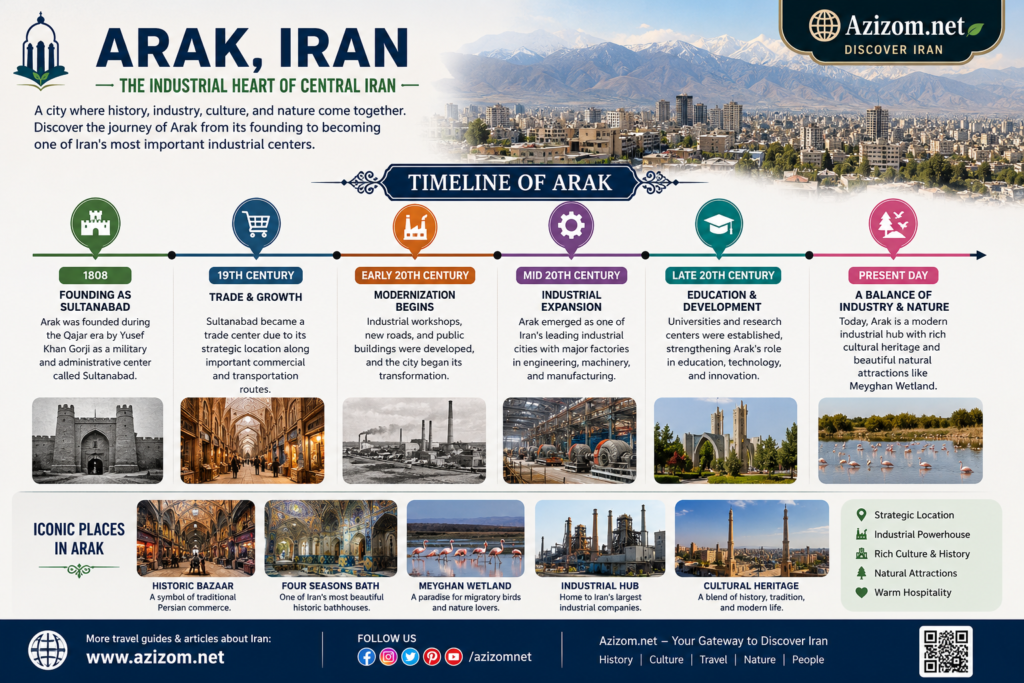
Arak’s history begins in the early nineteenth century during the rule of the Qajar Dynasty.
The city was originally founded as Sultanabad by Yusef Khan Gorji around 1808. Unlike many Iranian cities that developed gradually over centuries, Sultanabad was intentionally planned and constructed as a military and administrative center.
The original city featured:
- Fortified walls
- Defensive towers
- Organized neighborhoods
- Commercial districts
- Government buildings
The strategic location of Sultanabad soon encouraged trade and economic activity. Merchants traveling between major Iranian cities began using the settlement as a commercial stop, helping it grow into an important regional marketplace.
As Iran entered the twentieth century, the city experienced rapid modernization. Industrial investments, improved transportation infrastructure, and population growth transformed Sultanabad into the modern city now known as Arak.
Despite extensive development, visitors can still find traces of its Qajar-era heritage throughout the city.
The Historic Bazaar of Arak
One of the most important cultural attractions in Arak is its historic bazaar.
Built during the Qajar period, the Bazaar of Arak remains one of the finest examples of traditional Persian urban design in central Iran.
The market was carefully designed to support both commerce and social interaction. Even today, it serves as a lively gathering place where locals shop, meet friends, and conduct business.
Visitors exploring the bazaar will find:
- Traditional Persian carpets
- Handmade textiles
- Jewelry
- Copperware
- Local handicrafts
- Spices and herbs
- Traditional sweets
- Household goods
Architecturally, the bazaar features elegant brickwork, arched passageways, and covered corridors that provide shade throughout the year.
For travelers interested in photography, culture, and local life, the Bazaar of Arak offers an authentic glimpse into everyday Iranian society.
Hammam-e Chahar Fasl – The Four Seasons Bath
Among Arak’s most famous historical landmarks is the magnificent Hammam-e Chahar Fasl, commonly known as the Four Seasons Bath.
Constructed during the late Qajar era, this traditional Persian bathhouse is considered one of the most beautiful historical baths in Iran.
The structure earned its name from elaborate tile panels depicting scenes from the four seasons:
- Spring
- Summer
- Autumn
- Winter
The bathhouse showcases exceptional examples of Persian craftsmanship, including:
- Colorful tile mosaics
- Decorative ceilings
- Geometric designs
- Intricate artwork
- Traditional bathing chambers
Today the building functions as a museum, preserving an important aspect of Persian social and architectural history.
Visitors can admire centuries-old artistic traditions while learning about daily life in Iran during the Qajar period.
Meyghan Wetland – Arak’s Natural Wonder
While Arak is famous for industry, it also boasts one of Iran’s most valuable ecological treasures.
Located northeast of the city, Meyghan Wetland is an internationally recognized natural habitat that attracts thousands of migratory birds every year.
The wetland ecosystem supports a diverse range of wildlife and serves as an important stop along migration routes connecting Europe, Asia, and Africa.
Bird species frequently observed include:
- Flamingos
- Pelicans
- Herons
- Ducks
- Geese
- Various migratory birds
The area’s unique salt lake environment creates spectacular scenery, especially during sunrise and sunset when reflections transform the landscape into a photographer’s paradise.
Nature lovers, birdwatchers, and eco-tourists often rank Meyghan Wetland among the most impressive natural attractions in central Iran.
Why Arak Became an Industrial Giant
Arak is often referred to as the industrial heart of central Iran.
Several factors contributed to this reputation:
Strategic Location
Its central position allows efficient transportation of goods throughout the country.
Transportation Infrastructure
Railways and highways connect Arak to major Iranian cities and industrial regions.
Skilled Workforce
Educational institutions provide trained engineers, technicians, and industrial specialists.
Government Investment
Decades of industrial development programs have established Arak as a major manufacturing center.
Today, industries operating in Arak include:
- Heavy engineering
- Machinery manufacturing
- Energy equipment production
- Railway industries
- Metal processing
- Construction materials
- Industrial technology
Many of Iran’s largest industrial enterprises have facilities located in or around the city.
Education and Research
Arak is also an important educational center.
The city hosts several universities and research institutions that contribute to scientific advancement and workforce development.
Students from across Iran come to Arak to study:
- Engineering
- Technology
- Applied sciences
- Medicine
- Agriculture
- Business
The relationship between education and industry has played a major role in Arak’s continued economic success.
Culture and Local Traditions
Although modern industry dominates much of Arak’s economy, local residents maintain strong connections to Persian traditions and cultural heritage.
Visitors can experience:
- Traditional celebrations
- Family gatherings
- Persian hospitality
- Cultural festivals
- Local music
- Handicraft traditions
The city’s central location has encouraged cultural exchanges with neighboring provinces, creating a unique blend of customs and traditions.
The result is a community that embraces modernization while preserving its historical identity.
Traditional Cuisine of Arak
Food plays an important role in local culture.
The cuisine of Arak reflects the agricultural traditions of central Iran and offers visitors a variety of authentic Persian flavors.
Popular dishes include:
Ash
Traditional Persian soups made with vegetables, herbs, legumes, and grains.
Kebabs
Various grilled meat dishes served with rice, bread, and fresh herbs.
Khoresh
Rich Persian stews prepared with meat, vegetables, fruits, and aromatic spices.
Dairy Products
Fresh yogurt, cheese, butter, and other dairy products remain staples of the local diet.
Traditional Bread
Freshly baked bread accompanies nearly every meal.
Local Sweets
Regional pastries and desserts provide a delicious introduction to central Iranian culinary traditions.
Climate and Best Time to Visit
Arak experiences four distinct seasons.
Spring (April–June)
Spring is widely considered the best season for visiting. Mild temperatures and blooming landscapes create ideal conditions for sightseeing.
Summer (June–August)
Summers are generally warm and dry, making early morning and evening exploration more comfortable.
Autumn (September–October)
Autumn offers pleasant temperatures and colorful scenery throughout the surrounding countryside.
Winter (November–March)
Winter can bring cold weather and occasional snowfall, especially in nearby mountainous areas.
For most visitors, spring and autumn provide the most enjoyable travel experience.
Top Attractions Near Arak
In addition to the city’s main landmarks, travelers can explore nearby attractions including:
- Meyghan Wetland
- Traditional villages
- Mountain landscapes
- Historical caravan routes
- Natural parks
- Scenic countryside
- Local museums
- Cultural centers
These destinations showcase the diverse beauty of Markazi Province.
Why Visit Arak?
Arak offers a travel experience unlike many other destinations in Iran.
Reasons to visit include:
- Historical Qajar architecture
- Traditional Persian bazaars
- Four Seasons Bath Museum
- Meyghan Wetland
- Authentic local culture
- Industrial significance
- Educational importance
- Natural landscapes
- Regional cuisine
- Warm hospitality
Travelers seeking a deeper understanding of modern Iran often find Arak particularly rewarding.
Frequently Asked Questions
Is Arak worth visiting?
Yes. Arak offers a fascinating combination of history, culture, architecture, nature, and industrial significance.
What is Arak famous for?
Arak is best known for its industrial sector, historic bazaar, Four Seasons Bath, and Meyghan Wetland.
How far is Arak from Tehran?
The city is located approximately 290 kilometers southwest of Tehran.
What is the best season to visit Arak?
Spring and autumn are generally considered the most comfortable seasons for travel.
Is Arak suitable for eco-tourism?
Yes. Meyghan Wetland provides excellent opportunities for birdwatching, wildlife observation, and nature photography.
Key Takeaways
- Arak is the capital of Markazi Province in central Iran.
- Originally founded as Sultanabad during the Qajar era.
- One of Iran’s most important industrial and manufacturing cities.
- Home to the historic Bazaar of Arak.
- Features the famous Four Seasons Bath.
- Meyghan Wetland attracts migratory birds and eco-tourists.
- Offers a blend of modern industry and Persian culture.
- Ideal for travelers seeking lesser-known destinations in Iran.
Related Articles on Azizom.net
- Kerman – Gateway to the Lut Desert
- Kermanshah – The Historic Heart of Western Iran
- Yazd – The Ancient Desert City
- Hamedan – One of the World’s Oldest Cities
- Shiraz – The Cultural Capital of Iran
- Isfahan – The Jewel of Persian Architecture
- Tehran – Iran’s Dynamic Capital
Final Thoughts
Arak stands as one of the most unique cities in modern Iran. While its industrial achievements have earned national recognition, its historical landmarks, cultural heritage, and natural attractions reveal a much richer story.
From the bustling corridors of the historic bazaar to the artistic beauty of the Four Seasons Bath and the peaceful landscapes of Meyghan Wetland, Arak offers visitors a rare opportunity to experience multiple dimensions of Iranian life in a single destination.
For travelers interested in history, architecture, culture, industry, and nature, Arak represents one of central Iran’s most rewarding and underrated destinations.
Whether you are exploring Iran for the first time or seeking new places beyond the country’s famous tourist routes, Arak deserves a place on your travel itinerary.
Travel Disclaimer
Travel regulations, transportation schedules, accommodation availability, visa requirements, local restrictions, and attraction opening hours may change without notice. Readers should verify all travel information through official sources before making travel plans.
Historical Disclaimer
Historical information is based on publicly available references, local sources, and academic materials available at the time of publication. Interpretations and dates may vary among historians and institutions.
Cultural Disclaimer
This article is intended for educational and informational purposes. Cultural practices and traditions may differ between regions, communities, and generations.
Image Disclaimer
Images appearing on Azizom.net may be sourced from licensed providers, public-domain collections, tourism organizations, contributor submissions, or AI-assisted illustrations. All image rights remain with their respective owners where applicable.
Affiliate Disclosure
Some links on Azizom.net may be affiliate links like amazon . If readers purchase products or services through these links, Azizom.net may earn a commission at no additional cost to the buyer. Such commissions help support the continued operation of the website.
Copyright Notice
This article is the original intellectual property of Azizom.net. Unauthorized reproduction, distribution, or publication without permission is prohibited.
© Azizom.net – Discover Iran’s History, Culture, Heritage, and Hidden Gems